New ads.

Showing posts with label age. Show all posts

Wednesday, January 15, 2020

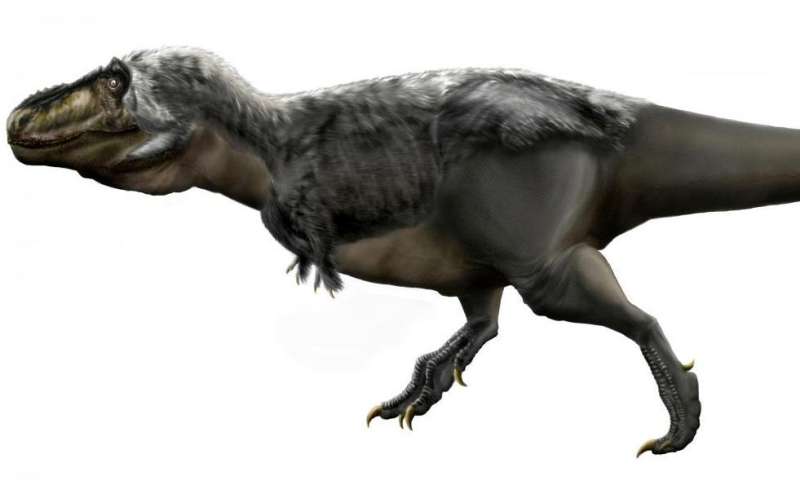
Researchers learn more about teen-age T. rex

Image result for Researchers learn more about teen-age T. rex

Researchers learn more about teen-age T. rex


Without a doubt, Tyrannosaurus rex is the most famous dinosaur in the world. The 40-foot-long predator with bone crushing teeth inside a five-foot long head are the stuff of legend. Now, a look within the bones of two mid-sized, immature T. rex allow scientists to learn about the tyrant king's terrible teens as well.
In the early 2000s, the fossil skeletons of two comparatively small T. rex were collected from Carter County, Montana, by Burpee Museum of Natural History in Rockford, Illinois. Nicknamed "Jane" and "Petey," the tyrannosaurs would have been slightly taller than a draft horse and twice as long.
The team led by Holly Woodward, Ph.D., from Oklahoma State University Center for Health Sciences studied Jane and Petey to better understand T. rex life history.
The study "Growing up Tyrannosaurus rex: histology refutes pygmy 'Nanotyrannus' and supports ontogenetic niche partitioning in juvenile Tyrannosaurus" appears in the peer-reviewed journal Science Advances.
Co-authors include Jack Horner, presidential fellow at Chapman University; Nathan Myhrvold, founder and CEO of Intellectual Ventures; Katie Tremaine, graduate student at Montana State University; Scott Williams, paleontology lab and field specialist at Museum of the Rockies; and Lindsay Zanno, division head of paleontology at the North Carolina Museum of Natural Sciences. Supplemental histological work was conducted at the Diane Gabriel Histology Labs at Museum of the Rockies/Montana State University.
"Historically, many museums would collect the biggest, most impressive fossils of a dinosaur species for display and ignore the others," said Woodward. "The problem is that those smaller fossils may be from younger animals. So, for a long while we've had large gaps in our understanding of how dinosaurs grew up, and T. rex is no exception."
The smaller size of Jane and Petey is what make them so incredibly important. Not only can scientists now study how the bones and proportions changed as T. rex matured, but they can also utilize paleohistology -- the study of fossil bone microstructure -- to learn about juvenile growth rates and ages. Woodward and her team removed thin slices from the leg bones of Jane and Petey and examined them at high magnification.
"To me, it's always amazing to find that if you have something like a huge fossilized dinosaur bone, it's fossilized on the microscopic level as well," Woodward said. "And by comparing these fossilized microstructures to similar features found in modern bone, we know they provide clues to metabolism, growth rate, and age."
The team determined that the small T. rex were growing as fast as modern-day warm-blooded animals such as mammals and birds. Woodward and her colleagues also found that by counting the annual rings within the bone, much like counting tree rings, Jane and Petey were teenaged T.rex when they died; 13 and 15 years old, respectively.
There had been speculation that the two small skeletons weren't T. rex at all, but a smaller pygmy relative Nanotyrannus. Study of the bones using histology led the researchers to the conclusion that the skeletons were juvenile T. rex and not a new pygmy species.
Instead, Woodward points out, because it took T. rex up to twenty years to reach adult size, the tyrant king probably underwent drastic changes as it matured. Juveniles such as Jane and Petey were fast, fleet footed, and had knife-like teeth for cutting, whereas adults were lumbering bone crushers. Not only that, but Woodward's team discovered that growing T. rex could do a neat trick: if its food source was scarce during a particular year, it just didn't grow as much. And if food was plentiful, it grew a lot.
"The spacing between annual growth rings record how much an individual grows from one year to the next. The spacing between the rings within Jane, Petey, and even older individuals is inconsistent -- some years the spacing is close together, and other years it's spread apart," said Woodward.
The research by Woodward and her team writes a new chapter in the early years of the world's most famous dinosaur, providing evidence that it assumed the crown of tyrant king long before it reached adult size.

Story Source:
Materials provided by Oklahoma State University Center for Health SciencesNote: Content may be edited for style and length.

Saturday, December 21, 2019

Researchers determine age for last known settlement by a direct ancestor to modern humans

Homo erectus skull (stock image).
Credit: © stockdevil / Adobe Stock

Homo erectus, one of modern humans' direct ancestors, was a wandering bunch. After the species dispersed from Africa about two million years ago, it colonized the ancient world, which included Asia and possibly Europe.
But about 400,000 years ago, Homo erectus essentially vanished. The lone exception was a spot called Ngandong, on the Indonesian island of Java. But scientists were unable to agree on a precise time period for the site -- until now.
In a new study published in the journal Nature, an international team of researchers led by the University of Iowa; Macquarie University; and the Institute of Technology Bandung, Indonesia, dates the last existence of Homo erectus at Ngandong between 108,000 and 117,000 years ago.
The researchers time-stamped the site by dating animal fossils from the same bonebed where 12 Homo erectus skull caps and two tibia had been found, and then dated the surrounding land forms -- mostly terraces below and above Ngandong -- to establish an accurate record for the primeval humans' possible last stand on Earth.
"This site is the last known appearance of Homo erectus found anywhere in the world," says Russell Ciochon, professor in the Department of Anthropology at Iowa and co-corresponding author on the study. "We can't say we dated the extinction, but we dated the last occurrence of it. We have no evidence Homo erectus lived later than that anywhere else."
The research team presents 52 new age estimates for the Ngandong evidence. They include animal fossil fragments and sediment from the rediscovered fossil bed where the original Homo erectus remains were found by Dutch surveyors in the 1930s, and a sequence of dates for the river terraces below and above the fossil site.
In addition, the researchers determined when mountains south of Ngandong first rose by dating stalagmites from caves in the Southern Mountains. This allowed them to determine when the Solo River began coursing through the Ngandong site, and the river terrace sequence was created.
"You have this incredible array of dates that are all consistent," Ciochon says. "This has to be the right range. That's why it's such a nice, tight paper. The dating is very consistent."
"The issues with the dating of Ngandong could only ever be resolved by an appreciation of the wider landscape," says Kira Westaway, associate professor at Macquarie University and a joint-lead author on the paper. "Fossils are the byproducts of complex landscape processes. We were able to nail the age of the site because we constrained the fossils within the river deposit, the river terrace, the sequence of terraces, and the volcanically active landscape."
Previous research by Ciochon and others shows Homo erectus hopscotched its way across the Indonesian archipelago, and arrived on the island of Java about 1.6 million years ago. The timing was good: The area around Ngandong was mostly grassland, the same environment that cradled the species in Africa. Plants and animals were abundant. While the species continued to venture to other islands, Java, it appears, likely remained home -- or least a way station -- to some bands of the species.
However, around 130,000 years ago, the environment at Ngandong changed, and so did Homo erectus's fortunes.
"There was a change in climate," Ciochon explains. "We know the fauna changed from open country, grassland, to a tropical rainforest (extending southward from today's Malaysia). Those were not the plants and animals that Homo erectus was used to, and the species just could not adapt."
Ciochon co-led a 12-member, international team that dug at Ngandong in 2008 and in 2010, accompanied by Yan Rizal and Yahdi Zaim, the lead researchers from the Institute of Technology, Bandung, on the excavation. Using notes from the Dutch surveyors' excavation in the 1930s, the team found the original Homo erectus bone bed at Ngandong and re-exposed it, collecting and dating 867 animal fossil fragments. Meanwhile, Westaway's team had been dating the surrounding landscapes, such as the terraces, during that time.
"It was coincidental" the teams were working in the same place -- one group at the fossil bed, the other group dating the surrounding area, Ciochon says.
"With the data we had, we couldn't really date the Ngandong fossils," Ciochon continues. "We had dates on them, but they were minimum ages. So, we couldn't really say how old, although we knew we were in the ballpark. By working with Kira, who had vast amount of dating data for the terraces, mountains, and other landscape features, we were able to provide precise regional chronological and geomorphic contexts for the Ngandong site."
Researchers from multiple institutions contributed to the manuscript, including those from the Institute of Technology in Bandung, Indonesia; the University of Wollongong, Australia; the University of Texas-Austin; Griffith University in Nathan, Australia; Southern Cross University in Lismore, Australia; the University of Oxford, United Kingdom; the Geological Agency in Bandung; the University of Queensland in Brisbane Australia; the University of New England in Armidale, Australia; the University of Copenhagen in Denmark; Minnesota State University-Mankato; Bluestone Heights in Cleveland, Ohio; the University of Alberta in Edmonton, Canada; Rutgers University; Indiana University; and Illinois State University.
Rizal is a joint-lead author on the paper. E. Arthur Bettis III, emeritus professor in the Department of Earth and Environmental Sciences at Iowa, is a contributing author.
Funders include the University of Iowa, the Australian Research Council, the Wenner-Gren Foundation for Anthropological Research, the Geological Survey Institute in Bandung, and the Villum Foundation.

Story Source:
Materials provided by University of Iowa. Original written by Richard C. Lewis. Note: Content may be edited for style and length.

Saturday, December 7, 2019

Mystery of how early animals survived ice age

Mystery of how early animals survived ice age

How did life survive the most severe ice age? A McGill University-led research team has found the first direct evidence that glacial meltwater provided a crucial lifeline to eukaryotes during Snowball Earth, when the oceans were cut off from life-giving oxygen, answering a question puzzling scientists for years.
In a new study published in the Proceedings of the National Academy of Sciences, researchers studied iron-rich rocks left behind by glacial deposits in Australia, Namibia, and California to get a window into the environmental conditions during the ice age. Using geological maps and clues from locals, they hiked to rock outcrops, navigating challenging trails to track down the rock formations.
By examining the chemistry of the iron formations in these rocks, the researchers were able to estimate the amount of oxygen in the oceans around 700 million years ago and better understand the effects this would have had on all oxygen-dependent marine life, including the earliest animals like simple sponges.
"The evidence suggests that although much of the oceans during the deep freeze would have been uninhabitable due to a lack of oxygen, in areas where the grounded ice sheet begins to float there was a critical supply of oxygenated meltwater. This trend can be explained by what we call a 'glacial oxygen pump'; air bubbles trapped in the glacial ice are released into the water as it melts, enriching it with oxygen," says Maxwell Lechte, a postdoctoral researcher in the Department of Earth and Planetary Sciences under the supervision of Galen Halverson at McGill University.
Around 700 million years ago, the Earth experienced the most severe ice age of its history, threatening the survival of much of the planet's life. Previous research has suggested that oxygen-dependent life may have been restricted to meltwater puddles on the surface of the ice, but this study provides new evidence of oxygenated marine environments.
"The fact that the global freeze occurred before the evolution of complex animals suggests a link between Snowball Earth and animal evolution. These harsh conditions could have stimulated their diversification into more complex forms," says Lechte, who is also the study's lead author.
Lechte points out that while the findings focus on the availability of oxygen, primitive eukaryotes would also have needed food to survive the harsh conditions of the ice age. Further research is needed to explore how these environments might have sustained a food web. A starting point might be modern ice environments that host complex ecosystems today.
"This study actually solves two mysteries about the Snowball Earth at once. It not only provides explanation for how early animals may have survived global glaciation, but also eloquently explains the return of iron deposits in the geological record after an absence of over a billion years," says Professor Galen Halverson.
About the study
"Subglacial meltwater supported aerobic marine habitats during Snowball Earth" by Maxwell Lechte, Malcolm Wallace, Ashleigh van Smeerdijk Hood, Weiqiang Li, Ganqing Jiang, Galen Halverson, Dan Asael, Stephanie McColl, and Noah Planavsky is published in Proceedings of the National Academy of Sciences of the United States of America. The paper is a collaboration between McGill University, University of Melbourne, Nanjing University, University of Nevada, Las Vegas, and Yale University.
This work received financial support from the Australian Government Research Training Program Scholarship, the Albert Shimmins Award, the Australian Research Council Discovery Grant, the NASA Astrobiology Postdoctoral Fellowship, the Puzey Fellowship, and the Australian Research Council.

Story Source:
Materials provided by McGill UniversityNote: Content may be edited for style and length.