Showing posts with label years. Show all posts
Showing posts with label years. Show all posts
Friday, December 6, 2024
Hidden fat predicts Alzheimer's 20 years ahead of symptoms
Researchers have linked a specific type of body fat to the abnormal proteins in the brain that are hallmarks of Alzheimer's disease up to 20 years before the earliest symptoms of dementia appear, according to a study being presented today at the annual meeting of the Radiological Society of North America (RSNA). The researchers emphasized that lifestyle modifications targeted at reducing this fat could influence the development of Alzheimer's disease.
 "This crucial result was discovered because we investigated Alzheimer's disease pathology as early as midlife -- in the 40s and 50s -- when the disease pathology is at its earliest stages, and potential modifications like weight loss and reducing visceral fat are more effective as a means of preventing or delaying the onset of the disease," said lead study author Mahsa Dolatshahi, M.D., M.P.H., post-doctoral research associate at Mallinckrodt Institute of Radiology (MIR) at Washington University School of Medicine in St. Louis, Missouri.
An estimated 6.9 million Americans, aged 65 and older, are living with Alzheimer's disease, according to the Alzheimer's Association. The association estimates this number could grow to 13 million by 2050, barring the development of medical breakthroughs to prevent or cure the disease.
For the study, the researchers focused on the link between modifiable lifestyle-related factors, such as obesity, body fat distribution and metabolic aspects, and Alzheimer's disease pathology.
A total of 80 cognitively normal midlife individuals (average age: 49.4 years, female: 62.5%,) were included in the study. Approximately 57.5% of participants were obese, and the average body mass index (BMI) of the participants was 32.31. The participants underwent brain positron emission tomography (PET), body MRI and metabolic assessment (glucose and insulin measurements), as well as a lipid (cholesterol) panel. MRI scans of the abdomen were performed to measure the volume of the subcutaneous fat (the fat under skin) and visceral fat (deep hidden fat surrounding the organs).
"We investigated the association of BMI, visceral fat, subcutaneous fat, liver fat fraction, thigh fat and muscle, as well as insulin resistance and HDL (good cholesterol), with amyloid and tau deposition in Alzheimer's disease," said Dr. Dolatshahi, a member of the Raji Lab at MIR's Neuroimaging Labs Research Center.
Thigh muscle scans were used to measure volume of muscle and fat. Alzheimer's disease pathology was measured using PET scans with tracers that bind to amyloid plaques and tau tangles that accumulate in the brains of people with Alzheimer's disease. The findings revealed that higher levels of visceral fat were related to increased amyloid, accounting for 77% of the effect of high BMI on amyloid accumulation. Other types of fat did not explain obesity-related increased Alzheimer's pathology.
"Our study showed that higher visceral fat was associated with higher PET levels of the two hallmark pathologic proteins of Alzheimer's disease -- amyloid and tau," Dr. Dolatshahi said. "To our knowledge, our study is the only one to demonstrate these findings at midlife where our participants are decades out from developing the earliest symptoms of the dementia that results from Alzheimer's disease."
The study also showed that higher insulin resistance and lower HDL were associated with high amyloid in the brain. The effects of visceral fat on amyloid pathology were partially reduced in people with higher HDL.
"A key implication of our work is that managing Alzheimer's risk in obesity will need to involve targeting the related metabolic and lipid issues that often arise with higher body fat," said senior study author Cyrus A. Raji, M.D., Ph.D., associate professor of radiology at MIR.
Although previous studies have shown the role of high BMI in damaging the cells of the brain, no similar study has investigated the differential role of visceral and subcutaneous fat or metabolic profile, especially in terms of Alzheimer's amyloid pathology as early as midlife, Dr. Dolatshahi pointed out.
"This study goes beyond using BMI to characterize body fat more accurately with MRI and, in so doing, reveals key insights about why obesity can increase risk for Alzheimer's disease," Dr. Dolatshahi said.
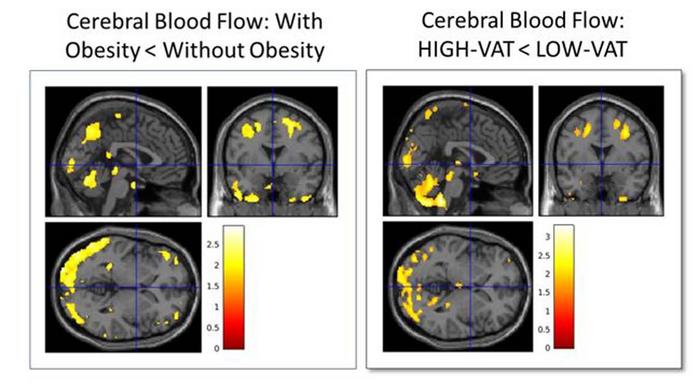
Drs. Raji, Dolatshahi and colleagues are also presenting a study at RSNA 2024 that shows how obesity and visceral fat reduce blood flow in the brain.
In that study, the researchers performed brain and abdominal MRI on cognitively normal midlife individuals with a wide range of BMI and compared whole-brain and regional cerebral blood flow on brain MRI in individuals with high vs. low visceral and subcutaneous fat. The high visceral fat group showed lower whole-brain blood flow. No significant difference was observed in cerebral blood flow in the groups with high vs. low subcutaneous fat.
"This work will have a considerable impact on public health because nearly three out of four Americans are overweight or obese," Dr. Raji said. "Knowing that visceral obesity negatively affects the brain opens up the possibility that treatment with lifestyle modifications or appropriate weight-loss drugs could improve cerebral blood flow and potentially lower the burden of and reduce the risk for Alzheimer's disease."
Other co-authors are Paul K. Commean, B.E.E., Mahshid Naghashzadeh, M.S., Sara Hosseinzadeh Kassani, Ph.D., Jake Weeks, B.S., Caitlyn Nguyen, B.S., Abby McBee-Kemper, B.S., Nancy Hantler, B.S., LaKisha Lloyd, M.Sc., Shaney Flores, M.S., Yifei Xu, M.S., Jingxia Liu, Ph.D., Claude B. Sirlin, M.D., Bettina Mittendorfer, Ph.D., Joseph E. Ippolito, M.D., Ph.D., John C. Morris, M.D., and Tammie L.S. Benzinger, M.D., Ph.D. This study was awarded the RSNA Trainee Research Prize.
"This crucial result was discovered because we investigated Alzheimer's disease pathology as early as midlife -- in the 40s and 50s -- when the disease pathology is at its earliest stages, and potential modifications like weight loss and reducing visceral fat are more effective as a means of preventing or delaying the onset of the disease," said lead study author Mahsa Dolatshahi, M.D., M.P.H., post-doctoral research associate at Mallinckrodt Institute of Radiology (MIR) at Washington University School of Medicine in St. Louis, Missouri.
An estimated 6.9 million Americans, aged 65 and older, are living with Alzheimer's disease, according to the Alzheimer's Association. The association estimates this number could grow to 13 million by 2050, barring the development of medical breakthroughs to prevent or cure the disease.
For the study, the researchers focused on the link between modifiable lifestyle-related factors, such as obesity, body fat distribution and metabolic aspects, and Alzheimer's disease pathology.
A total of 80 cognitively normal midlife individuals (average age: 49.4 years, female: 62.5%,) were included in the study. Approximately 57.5% of participants were obese, and the average body mass index (BMI) of the participants was 32.31. The participants underwent brain positron emission tomography (PET), body MRI and metabolic assessment (glucose and insulin measurements), as well as a lipid (cholesterol) panel. MRI scans of the abdomen were performed to measure the volume of the subcutaneous fat (the fat under skin) and visceral fat (deep hidden fat surrounding the organs).
"We investigated the association of BMI, visceral fat, subcutaneous fat, liver fat fraction, thigh fat and muscle, as well as insulin resistance and HDL (good cholesterol), with amyloid and tau deposition in Alzheimer's disease," said Dr. Dolatshahi, a member of the Raji Lab at MIR's Neuroimaging Labs Research Center.
Thigh muscle scans were used to measure volume of muscle and fat. Alzheimer's disease pathology was measured using PET scans with tracers that bind to amyloid plaques and tau tangles that accumulate in the brains of people with Alzheimer's disease. The findings revealed that higher levels of visceral fat were related to increased amyloid, accounting for 77% of the effect of high BMI on amyloid accumulation. Other types of fat did not explain obesity-related increased Alzheimer's pathology.
"Our study showed that higher visceral fat was associated with higher PET levels of the two hallmark pathologic proteins of Alzheimer's disease -- amyloid and tau," Dr. Dolatshahi said. "To our knowledge, our study is the only one to demonstrate these findings at midlife where our participants are decades out from developing the earliest symptoms of the dementia that results from Alzheimer's disease."
The study also showed that higher insulin resistance and lower HDL were associated with high amyloid in the brain. The effects of visceral fat on amyloid pathology were partially reduced in people with higher HDL.
"A key implication of our work is that managing Alzheimer's risk in obesity will need to involve targeting the related metabolic and lipid issues that often arise with higher body fat," said senior study author Cyrus A. Raji, M.D., Ph.D., associate professor of radiology at MIR.
Although previous studies have shown the role of high BMI in damaging the cells of the brain, no similar study has investigated the differential role of visceral and subcutaneous fat or metabolic profile, especially in terms of Alzheimer's amyloid pathology as early as midlife, Dr. Dolatshahi pointed out.
"This study goes beyond using BMI to characterize body fat more accurately with MRI and, in so doing, reveals key insights about why obesity can increase risk for Alzheimer's disease," Dr. Dolatshahi said.
Drs. Raji, Dolatshahi and colleagues are also presenting a study at RSNA 2024 that shows how obesity and visceral fat reduce blood flow in the brain.
In that study, the researchers performed brain and abdominal MRI on cognitively normal midlife individuals with a wide range of BMI and compared whole-brain and regional cerebral blood flow on brain MRI in individuals with high vs. low visceral and subcutaneous fat. The high visceral fat group showed lower whole-brain blood flow. No significant difference was observed in cerebral blood flow in the groups with high vs. low subcutaneous fat.
"This work will have a considerable impact on public health because nearly three out of four Americans are overweight or obese," Dr. Raji said. "Knowing that visceral obesity negatively affects the brain opens up the possibility that treatment with lifestyle modifications or appropriate weight-loss drugs could improve cerebral blood flow and potentially lower the burden of and reduce the risk for Alzheimer's disease."
Other co-authors are Paul K. Commean, B.E.E., Mahshid Naghashzadeh, M.S., Sara Hosseinzadeh Kassani, Ph.D., Jake Weeks, B.S., Caitlyn Nguyen, B.S., Abby McBee-Kemper, B.S., Nancy Hantler, B.S., LaKisha Lloyd, M.Sc., Shaney Flores, M.S., Yifei Xu, M.S., Jingxia Liu, Ph.D., Claude B. Sirlin, M.D., Bettina Mittendorfer, Ph.D., Joseph E. Ippolito, M.D., Ph.D., John C. Morris, M.D., and Tammie L.S. Benzinger, M.D., Ph.D. This study was awarded the RSNA Trainee Research Prize.

Wednesday, March 11, 2020
Ancient shell shows days were half-hour shorter 70 million years ago

\Dinosaur scene illustration (stock image).
Earth turned faster at the end of the time of the dinosaurs than it does today, rotating 372 times a year, compared to the current 365, according to a new study of fossil mollusk shells from the late Cretaceous. This means a day lasted only 23 and a half hours, according to the new study in AGU's journal Paleoceanography and Paleoclimatology.
The ancient mollusk, from an extinct and wildly diverse group known as rudist clams, grew fast, laying down daily growth rings. The new study used lasers to sample minute slices of shell and count the growth rings more accurately than human researchers with microscopes.
The growth rings allowed the researchers to determine the number of days in a year and more accurately calculate the length of a day 70 million years ago. The new measurement informs models of how the Moon formed and how close to Earth it has been over the 4.5-billion-year history of the Earth-Moon gravitational dance.
The new study also found corroborating evidence that the mollusks harbored photosynthetic symbionts that may have fueled reef-building on the scale of modern-day corals.
The high resolution obtained in the new study combined with the fast growth rate of the ancient bivalves revealed unprecedented detail about how the animal lived and the water conditions it grew in, down to a fraction of a day.
"We have about four to five datapoints per day, and this is something that you almost never get in geological history. We can basically look at a day 70 million years ago. It's pretty amazing," said Niels de Winter, an analytical geochemist at Vrije Universiteit Brussel and the lead author of the new study.
Climate reconstructions of the deep past typically describe long term changes that occur on the scale of tens of thousands of years. Studies like this one give a glimpse of change on the timescale of living things and have the potential to bridge the gap between climate and weather models.
Chemical analysis of the shell indicates ocean temperatures were warmer in the Late Cretaceous than previously appreciated, reaching 40 degrees Celsius (104 degrees Fahrenheit) in summer and exceeding 30 degrees Celsius (86 degrees Fahrenheit) in winter. The summer high temperatures likely approached the physiological limits for mollusks, de Winter said.
"The high fidelity of this data-set has allowed the authors to draw two particularly interesting inferences that help to sharpen our understanding of both Cretaceous astrochronology and rudist palaeobiology," said Peter Skelton, a retired lecturer of palaeobiology at The Open University and a rudist expert unaffiliated with the new study.
Ancient reef-builders
The new study analyzed a single individual that lived for over nine years in a shallow seabed in the tropics -- a location which is now, 70-million-years later, dry land in the mountains of Oman.
Torreites sanchezi mollusks look like tall pint glasses with lids shaped like bear claw pastries. The ancient mollusks had two shells, or valves, that met in a hinge, like asymmetrical clams, and grew in dense reefs, like modern oysters. They thrived in water several degrees warmer worldwide than modern oceans.
In the late Cretaceous, rudists like T. sanchezi dominated the reef-building niche in tropical waters around the world, filling the role held by corals today. They disappeared in the same event that killed the non-avian dinosaurs 66 million years ago.
"Rudists are quite special bivalves. There's nothing like it living today," de Winter said. "In the late Cretaceous especially, worldwide most of the reef builders are these bivalves. So they really took on the ecosystem building role that the corals have nowadays."
The new method focused a laser on small bits of shell, making holes 10 micrometers in diameter, or about as wide as a red blood cell. Trace elements in these tiny samples reveal information about the temperature and chemistry of the water at the time the shell formed. The analysis provided accurate measurements of the width and number of daily growth rings as well as seasonal patterns. The researchers used seasonal variations in the fossilized shell to identify years.
The new study found the composition of the shell changed more over the course of a day than over seasons, or with the cycles of ocean tides. The fine-scale resolution of the daily layers shows the shell grew much faster during the day than at night
"This bivalve had a very strong dependence on this daily cycle, which suggests that it had photosymbionts," de Winter said. "You have the day-night rhythm of the light being recorded in the shell."
This result suggests daylight was more important to the lifestyle of the ancient mollusk than might be expected if it fed itself primarily by filtering food from the water, like modern day clams and oysters, according to the authors. De Winter said the mollusks likely had a relationship with an indwelling symbiotic species that fed on sunlight, similar to living giant clams, which harbor symbiotic algae.
"Until now, all published arguments for photosymbiosis in rudists have been essentially speculative, based on merely suggestive morphological traits, and in some cases were demonstrably erroneous. This paper is the first to provide convincing evidence in favor of the hypothesis," Skelton said, but cautioned that the new study's conclusion was specific to Torreites and could not be generalized to other rudists.
Moon retreat
De Winter's careful count of the number of daily layers found 372 for each yearly interval. This was not a surprise, because scientists know days were shorter in the past. The result is, however, the most accurate now available for the late Cretaceous, and has a surprising application to modeling the evolution of the Earth-Moon system.
The length of a year has been constant over Earth's history, because Earth's orbit around the Sun does not change. But the number of days within a year has been shortening over time because days have been growing longer. The length of a day has been growing steadily longer as friction from ocean tides, caused by the Moon's gravity, slows Earth's rotation.
The pull of the tides accelerates the Moon a little in its orbit, so as Earth's spin slows, the Moon moves farther away. The moon is pulling away from Earth at 3.82 centimeters (1.5 inches) per year. Precise laser measurements of distance to the Moon from Earth have demonstrated this increasing distance since the Apollo program left helpful reflectors on the Moon's surface.
But scientists conclude the Moon could not have been receding at this rate throughout its history, because projecting its progress linearly back in time would put the Moon inside the Earth only 1.4 billion years ago. Scientists know from other evidence that the Moon has been with us much longer, most likely coalescing in the wake of a massive collision early in Earth's history, over 4.5 billion years ago. So the Moon's rate of retreat has changed over time, and information from the past, like a year in the life of an ancient clam, helps researchers reconstruct that history and model of the formation of the moon.
Because in the history of the Moon, 70 million years is a blink in time, de Winter and his colleagues hope to apply their new method to older fossils and catch snapshots of days even deeper in time.
Story Source:
Materials provided by American Geophysical Union. Note: Content may be edited for style and length.
Wednesday, January 15, 2020
Scientists find oldest-known fossilized digestive tract -- 550 million years

Scientists find oldest-known fossilized digestive tract -- 550 million years
A 550-million-year-old fossilized digestive tract found in the Nevada desert could be a key find in understanding the early history of animals on Earth.
Over a half-billion years ago, life on Earth was composed of simple ocean organisms unlike anything living in today's oceans. Then, beginning about 540 million years ago, animal structures changed dramatically.
During this time, ancestors of many animal groups we know today appeared, such as primitive crustaceans and worms, yet for years scientists did not know how these two seemingly unrelated communities of animals were connected, until now. An analysis of tubular fossils by scientists led by Jim Schiffbauer at the University of Missouri provides evidence of a 550 million-year-old digestive tract -- one of the oldest known examples of fossilized internal anatomical structures -- and reveals what scientists believe is a possible answer to the question of how these animals are connected.
The study was published in Nature Communications, a journal of Nature.
"Not only are these structures the oldest guts yet discovered, but they also help to resolve the long-debated evolutionary positioning of this important fossil group," said Schiffbauer, an associate professor of geological sciences in the MU College of Arts and Science and director of the X-ray Microanalysis Core facility. "These fossils fit within a very recognizable group of organisms -- the cloudinids -- that scientists use to identify the last 10 to 15 million years of the Ediacaran Period, or the period of time just before the Cambrian Explosion. We can now say that their anatomical structure appears much more worm-like than coral-like."
The Cambrian Explosion is widely considered by scientists to be the point in history of life on Earth when the ancestors of many animal groups we know today emerged.
In the study, the scientists used MU's X-ray Microanalysis Core facility to take a unique analytical approach for geological science -- micro-CT imaging -- that created a digital 3D image of the fossil. This technique allowed the scientists to view what was inside the fossil structure.
"With CT imaging, we can quickly assess key internal features and then analyze the entire fossil without potentially damaging it," said co-author Tara Selly, a research assistant professor in the Department of Geological Sciences and assistant director of the X-ray Microanalysis Core facility.
The study, "Discovery of bilaterian-type through-guts in cloudinomorphs from the terminal Ediacaran Period," was published in Nature Communications. Other authors include Sarah Jacquet from MU; Rachel Merz from Swarthmore College; Michael Strange from the University of Nevada, Las Vegas; Yaoping Cai from Northwest University in Xi'an, China; and Lyle Nelson and Emmy Smith from Johns Hopkins University.
Funding was provided by grants from the NSF Sedimentary Geology and Paleobiology Program (CAREER 1652351) and Instrumentation and Facilities Program (1636643). The content is solely the responsibility of the authors and does not necessarily represent the official views of the funding agencies.
Story Source:
Materials provided by University of Missouri-Columbia. Note: Content may be edited for style and length.
Subscribe to:
Posts (Atom)