Showing posts with label fat. Show all posts
Showing posts with label fat. Show all posts
Friday, December 6, 2024
Hidden fat predicts Alzheimer's 20 years ahead of symptoms
Researchers have linked a specific type of body fat to the abnormal proteins in the brain that are hallmarks of Alzheimer's disease up to 20 years before the earliest symptoms of dementia appear, according to a study being presented today at the annual meeting of the Radiological Society of North America (RSNA). The researchers emphasized that lifestyle modifications targeted at reducing this fat could influence the development of Alzheimer's disease.
 "This crucial result was discovered because we investigated Alzheimer's disease pathology as early as midlife -- in the 40s and 50s -- when the disease pathology is at its earliest stages, and potential modifications like weight loss and reducing visceral fat are more effective as a means of preventing or delaying the onset of the disease," said lead study author Mahsa Dolatshahi, M.D., M.P.H., post-doctoral research associate at Mallinckrodt Institute of Radiology (MIR) at Washington University School of Medicine in St. Louis, Missouri.
An estimated 6.9 million Americans, aged 65 and older, are living with Alzheimer's disease, according to the Alzheimer's Association. The association estimates this number could grow to 13 million by 2050, barring the development of medical breakthroughs to prevent or cure the disease.
For the study, the researchers focused on the link between modifiable lifestyle-related factors, such as obesity, body fat distribution and metabolic aspects, and Alzheimer's disease pathology.
A total of 80 cognitively normal midlife individuals (average age: 49.4 years, female: 62.5%,) were included in the study. Approximately 57.5% of participants were obese, and the average body mass index (BMI) of the participants was 32.31. The participants underwent brain positron emission tomography (PET), body MRI and metabolic assessment (glucose and insulin measurements), as well as a lipid (cholesterol) panel. MRI scans of the abdomen were performed to measure the volume of the subcutaneous fat (the fat under skin) and visceral fat (deep hidden fat surrounding the organs).
"We investigated the association of BMI, visceral fat, subcutaneous fat, liver fat fraction, thigh fat and muscle, as well as insulin resistance and HDL (good cholesterol), with amyloid and tau deposition in Alzheimer's disease," said Dr. Dolatshahi, a member of the Raji Lab at MIR's Neuroimaging Labs Research Center.
Thigh muscle scans were used to measure volume of muscle and fat. Alzheimer's disease pathology was measured using PET scans with tracers that bind to amyloid plaques and tau tangles that accumulate in the brains of people with Alzheimer's disease. The findings revealed that higher levels of visceral fat were related to increased amyloid, accounting for 77% of the effect of high BMI on amyloid accumulation. Other types of fat did not explain obesity-related increased Alzheimer's pathology.
"Our study showed that higher visceral fat was associated with higher PET levels of the two hallmark pathologic proteins of Alzheimer's disease -- amyloid and tau," Dr. Dolatshahi said. "To our knowledge, our study is the only one to demonstrate these findings at midlife where our participants are decades out from developing the earliest symptoms of the dementia that results from Alzheimer's disease."
The study also showed that higher insulin resistance and lower HDL were associated with high amyloid in the brain. The effects of visceral fat on amyloid pathology were partially reduced in people with higher HDL.
"A key implication of our work is that managing Alzheimer's risk in obesity will need to involve targeting the related metabolic and lipid issues that often arise with higher body fat," said senior study author Cyrus A. Raji, M.D., Ph.D., associate professor of radiology at MIR.
Although previous studies have shown the role of high BMI in damaging the cells of the brain, no similar study has investigated the differential role of visceral and subcutaneous fat or metabolic profile, especially in terms of Alzheimer's amyloid pathology as early as midlife, Dr. Dolatshahi pointed out.
"This study goes beyond using BMI to characterize body fat more accurately with MRI and, in so doing, reveals key insights about why obesity can increase risk for Alzheimer's disease," Dr. Dolatshahi said.
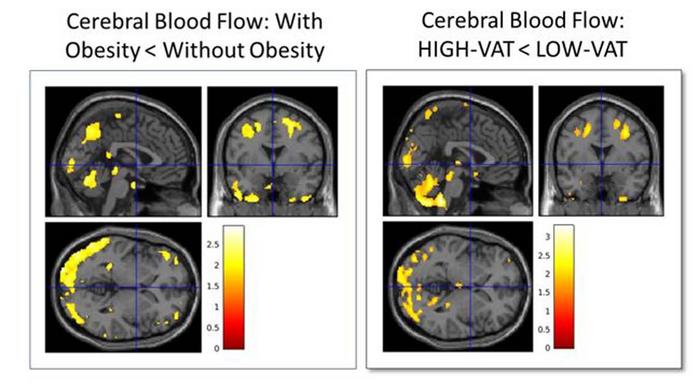
Drs. Raji, Dolatshahi and colleagues are also presenting a study at RSNA 2024 that shows how obesity and visceral fat reduce blood flow in the brain.
In that study, the researchers performed brain and abdominal MRI on cognitively normal midlife individuals with a wide range of BMI and compared whole-brain and regional cerebral blood flow on brain MRI in individuals with high vs. low visceral and subcutaneous fat. The high visceral fat group showed lower whole-brain blood flow. No significant difference was observed in cerebral blood flow in the groups with high vs. low subcutaneous fat.
"This work will have a considerable impact on public health because nearly three out of four Americans are overweight or obese," Dr. Raji said. "Knowing that visceral obesity negatively affects the brain opens up the possibility that treatment with lifestyle modifications or appropriate weight-loss drugs could improve cerebral blood flow and potentially lower the burden of and reduce the risk for Alzheimer's disease."
Other co-authors are Paul K. Commean, B.E.E., Mahshid Naghashzadeh, M.S., Sara Hosseinzadeh Kassani, Ph.D., Jake Weeks, B.S., Caitlyn Nguyen, B.S., Abby McBee-Kemper, B.S., Nancy Hantler, B.S., LaKisha Lloyd, M.Sc., Shaney Flores, M.S., Yifei Xu, M.S., Jingxia Liu, Ph.D., Claude B. Sirlin, M.D., Bettina Mittendorfer, Ph.D., Joseph E. Ippolito, M.D., Ph.D., John C. Morris, M.D., and Tammie L.S. Benzinger, M.D., Ph.D. This study was awarded the RSNA Trainee Research Prize.
"This crucial result was discovered because we investigated Alzheimer's disease pathology as early as midlife -- in the 40s and 50s -- when the disease pathology is at its earliest stages, and potential modifications like weight loss and reducing visceral fat are more effective as a means of preventing or delaying the onset of the disease," said lead study author Mahsa Dolatshahi, M.D., M.P.H., post-doctoral research associate at Mallinckrodt Institute of Radiology (MIR) at Washington University School of Medicine in St. Louis, Missouri.
An estimated 6.9 million Americans, aged 65 and older, are living with Alzheimer's disease, according to the Alzheimer's Association. The association estimates this number could grow to 13 million by 2050, barring the development of medical breakthroughs to prevent or cure the disease.
For the study, the researchers focused on the link between modifiable lifestyle-related factors, such as obesity, body fat distribution and metabolic aspects, and Alzheimer's disease pathology.
A total of 80 cognitively normal midlife individuals (average age: 49.4 years, female: 62.5%,) were included in the study. Approximately 57.5% of participants were obese, and the average body mass index (BMI) of the participants was 32.31. The participants underwent brain positron emission tomography (PET), body MRI and metabolic assessment (glucose and insulin measurements), as well as a lipid (cholesterol) panel. MRI scans of the abdomen were performed to measure the volume of the subcutaneous fat (the fat under skin) and visceral fat (deep hidden fat surrounding the organs).
"We investigated the association of BMI, visceral fat, subcutaneous fat, liver fat fraction, thigh fat and muscle, as well as insulin resistance and HDL (good cholesterol), with amyloid and tau deposition in Alzheimer's disease," said Dr. Dolatshahi, a member of the Raji Lab at MIR's Neuroimaging Labs Research Center.
Thigh muscle scans were used to measure volume of muscle and fat. Alzheimer's disease pathology was measured using PET scans with tracers that bind to amyloid plaques and tau tangles that accumulate in the brains of people with Alzheimer's disease. The findings revealed that higher levels of visceral fat were related to increased amyloid, accounting for 77% of the effect of high BMI on amyloid accumulation. Other types of fat did not explain obesity-related increased Alzheimer's pathology.
"Our study showed that higher visceral fat was associated with higher PET levels of the two hallmark pathologic proteins of Alzheimer's disease -- amyloid and tau," Dr. Dolatshahi said. "To our knowledge, our study is the only one to demonstrate these findings at midlife where our participants are decades out from developing the earliest symptoms of the dementia that results from Alzheimer's disease."
The study also showed that higher insulin resistance and lower HDL were associated with high amyloid in the brain. The effects of visceral fat on amyloid pathology were partially reduced in people with higher HDL.
"A key implication of our work is that managing Alzheimer's risk in obesity will need to involve targeting the related metabolic and lipid issues that often arise with higher body fat," said senior study author Cyrus A. Raji, M.D., Ph.D., associate professor of radiology at MIR.
Although previous studies have shown the role of high BMI in damaging the cells of the brain, no similar study has investigated the differential role of visceral and subcutaneous fat or metabolic profile, especially in terms of Alzheimer's amyloid pathology as early as midlife, Dr. Dolatshahi pointed out.
"This study goes beyond using BMI to characterize body fat more accurately with MRI and, in so doing, reveals key insights about why obesity can increase risk for Alzheimer's disease," Dr. Dolatshahi said.
Drs. Raji, Dolatshahi and colleagues are also presenting a study at RSNA 2024 that shows how obesity and visceral fat reduce blood flow in the brain.
In that study, the researchers performed brain and abdominal MRI on cognitively normal midlife individuals with a wide range of BMI and compared whole-brain and regional cerebral blood flow on brain MRI in individuals with high vs. low visceral and subcutaneous fat. The high visceral fat group showed lower whole-brain blood flow. No significant difference was observed in cerebral blood flow in the groups with high vs. low subcutaneous fat.
"This work will have a considerable impact on public health because nearly three out of four Americans are overweight or obese," Dr. Raji said. "Knowing that visceral obesity negatively affects the brain opens up the possibility that treatment with lifestyle modifications or appropriate weight-loss drugs could improve cerebral blood flow and potentially lower the burden of and reduce the risk for Alzheimer's disease."
Other co-authors are Paul K. Commean, B.E.E., Mahshid Naghashzadeh, M.S., Sara Hosseinzadeh Kassani, Ph.D., Jake Weeks, B.S., Caitlyn Nguyen, B.S., Abby McBee-Kemper, B.S., Nancy Hantler, B.S., LaKisha Lloyd, M.Sc., Shaney Flores, M.S., Yifei Xu, M.S., Jingxia Liu, Ph.D., Claude B. Sirlin, M.D., Bettina Mittendorfer, Ph.D., Joseph E. Ippolito, M.D., Ph.D., John C. Morris, M.D., and Tammie L.S. Benzinger, M.D., Ph.D. This study was awarded the RSNA Trainee Research Prize.

Wednesday, May 20, 2020
Our ability to focus may falter after eating one meal high in saturated fat

Our ability to focus may falter after eating one meal high in saturated fat
Fatty food may feel like a friend during these troubled times, but new research suggests that eating just one meal high in saturated fat can hinder our ability to concentrate -- not great news for people whose diets have gone south while they're working at home during the COVID-19 pandemic.
The study compared how 51 women performed on a test of their attention after they ate either a meal high in saturated fat or the same meal made with sunflower oil, which is high in unsaturated fat.
Their performance on the test was worse after eating the high-saturated-fat meal than after they ate the meal containing a healthier fat, signaling a link between that fatty food and the brain.
Researchers were also looking at whether a condition called leaky gut, which allows intestinal bacteria to enter the bloodstream, had any effect on concentration. Participants with leakier guts performed worse on the attention assessment no matter which meal they had eaten.
The loss of focus after a single meal was eye-opening for the researchers.
"Most prior work looking at the causative effect of the diet has looked over a period of time. And this was just one meal -- it's pretty remarkable that we saw a difference," said Annelise Madison, lead author of the study and a graduate student in clinical psychology at The Ohio State University.
Madison also noted that the meal made with sunflower oil, while low in saturated fat, still contained a lot of dietary fat.
"Because both meals were high-fat and potentially problematic, the high-saturated-fat meal's cognitive effect could be even greater if it were compared to a lower-fat meal," she said.
The study is published in the American Journal of Clinical Nutrition.
Madison works in the lab of Janice Kiecolt-Glaser, professor of psychiatry and psychology and director of the Institute for Behavioral Medicine Research at Ohio State. For this work, Madison conducted a secondary analysis of data from Kiecolt-Glaser's study assessing whether high-fat meals increased fatigue and inflammation among cancer survivors.
Women in the study completed a baseline assessment of their attention during a morning visit to the lab. The tool, called a continuous performance test, is a measure of sustained attention, concentration and reaction time based on 10 minutes of computer-based activities.
The high-fat meal followed: eggs, biscuits, turkey sausage and gravy containing 60 grams of fat, either a palmitic acid-based oil high in saturated fat or the lower-saturated-fat sunflower oil. Both meals totaled 930 calories and were designed to mimic the contents of various fast-food meals such as a Burger King double whopper with cheese or a McDonald's Big Mac and medium fries.
Five hours later, the women took the continuous performance test again. Between one and four weeks later, they repeated these steps, eating the opposite meal of what they had eaten on the first visit.
Researchers also analyzed participants' fasting baseline blood samples to determine whether they contained an inflammatory molecule that signals the presence of endotoxemia -- the toxin that escapes from the intestines and enters the bloodstream when the gut barrier is compromised.
After eating the meal high in saturated fat, all of the participating women were, on average, 11 percent less able to detect target stimuli in the attention assessment. Concentration lapses were also apparent in the women with signs of leaky gut: Their response times were more erratic and they were less able to sustain their attention during the 10-minute test.
"If the women had high levels of endotoxemia, it also wiped out the between-meal differences. They were performing poorly no matter what type of fat they ate," Madison said.
Though the study didn't determine what was going on in the brain, Madison said previous research has suggested that food high in saturated fat can drive up inflammation throughout the body, and possibly the brain. Fatty acids also can cross the blood-brain barrier.
"It could be that fatty acids are interacting with the brain directly. What it does show is the power of gut-related dysregulation," she said.
The statistical analysis accounted for other potential influences on cognition, including depressive symptoms and the participants' average dietary saturated fat consumption. The women in the study ate three standardized meals and fasted for 12 hours before each lab visit to reduce diet variations that could affect their physiological response to the high-fat meals.
The findings suggest concentration could be even more impaired in people stressed by the pandemic who are turning to fatty foods for comfort, Kiecolt-Glaser said.
"What we know is that when people are more anxious, a good subset of us will find high-saturated-fat food more enticing than broccoli," she said. "We know from other research that depression and anxiety can interfere with concentration and attention as well. When we add that on top of the high-fat meal, we could expect the real-world effects to be even larger."
This work was supported in part by the National Institutes of Health.
Additional co-authors, all from Ohio State, included Martha Belury, Rebecca Andridge, M. Rosie Shrout, Megan Renna, William Malarkey and Michael Bailey.
Story Source:
Materials provided by Ohio State University. Original written by Emily Caldwell. Note: Content may be edited for style and length.
Journal Reference:
- Janice K Kiecolt-Glaser, Michael T Bailey, William B Malarkey, Megan E Renna, M Rosie Shrout, Rebecca Andridge, Martha A Belury, Annelise A Madison. Afternoon distraction: a high-saturated-fat meal and endotoxemia impact postmeal attention in a randomized crossover trial. The American Journal of Clinical Nutrition, 2020; DOI: 10.1093/ajcn/nqaa085
Subscribe to:
Posts (Atom)