Showing posts with label Hidden. Show all posts
Showing posts with label Hidden. Show all posts
Friday, December 6, 2024
Hidden fat predicts Alzheimer's 20 years ahead of symptoms
Researchers have linked a specific type of body fat to the abnormal proteins in the brain that are hallmarks of Alzheimer's disease up to 20 years before the earliest symptoms of dementia appear, according to a study being presented today at the annual meeting of the Radiological Society of North America (RSNA). The researchers emphasized that lifestyle modifications targeted at reducing this fat could influence the development of Alzheimer's disease.
 "This crucial result was discovered because we investigated Alzheimer's disease pathology as early as midlife -- in the 40s and 50s -- when the disease pathology is at its earliest stages, and potential modifications like weight loss and reducing visceral fat are more effective as a means of preventing or delaying the onset of the disease," said lead study author Mahsa Dolatshahi, M.D., M.P.H., post-doctoral research associate at Mallinckrodt Institute of Radiology (MIR) at Washington University School of Medicine in St. Louis, Missouri.
An estimated 6.9 million Americans, aged 65 and older, are living with Alzheimer's disease, according to the Alzheimer's Association. The association estimates this number could grow to 13 million by 2050, barring the development of medical breakthroughs to prevent or cure the disease.
For the study, the researchers focused on the link between modifiable lifestyle-related factors, such as obesity, body fat distribution and metabolic aspects, and Alzheimer's disease pathology.
A total of 80 cognitively normal midlife individuals (average age: 49.4 years, female: 62.5%,) were included in the study. Approximately 57.5% of participants were obese, and the average body mass index (BMI) of the participants was 32.31. The participants underwent brain positron emission tomography (PET), body MRI and metabolic assessment (glucose and insulin measurements), as well as a lipid (cholesterol) panel. MRI scans of the abdomen were performed to measure the volume of the subcutaneous fat (the fat under skin) and visceral fat (deep hidden fat surrounding the organs).
"We investigated the association of BMI, visceral fat, subcutaneous fat, liver fat fraction, thigh fat and muscle, as well as insulin resistance and HDL (good cholesterol), with amyloid and tau deposition in Alzheimer's disease," said Dr. Dolatshahi, a member of the Raji Lab at MIR's Neuroimaging Labs Research Center.
Thigh muscle scans were used to measure volume of muscle and fat. Alzheimer's disease pathology was measured using PET scans with tracers that bind to amyloid plaques and tau tangles that accumulate in the brains of people with Alzheimer's disease. The findings revealed that higher levels of visceral fat were related to increased amyloid, accounting for 77% of the effect of high BMI on amyloid accumulation. Other types of fat did not explain obesity-related increased Alzheimer's pathology.
"Our study showed that higher visceral fat was associated with higher PET levels of the two hallmark pathologic proteins of Alzheimer's disease -- amyloid and tau," Dr. Dolatshahi said. "To our knowledge, our study is the only one to demonstrate these findings at midlife where our participants are decades out from developing the earliest symptoms of the dementia that results from Alzheimer's disease."
The study also showed that higher insulin resistance and lower HDL were associated with high amyloid in the brain. The effects of visceral fat on amyloid pathology were partially reduced in people with higher HDL.
"A key implication of our work is that managing Alzheimer's risk in obesity will need to involve targeting the related metabolic and lipid issues that often arise with higher body fat," said senior study author Cyrus A. Raji, M.D., Ph.D., associate professor of radiology at MIR.
Although previous studies have shown the role of high BMI in damaging the cells of the brain, no similar study has investigated the differential role of visceral and subcutaneous fat or metabolic profile, especially in terms of Alzheimer's amyloid pathology as early as midlife, Dr. Dolatshahi pointed out.
"This study goes beyond using BMI to characterize body fat more accurately with MRI and, in so doing, reveals key insights about why obesity can increase risk for Alzheimer's disease," Dr. Dolatshahi said.
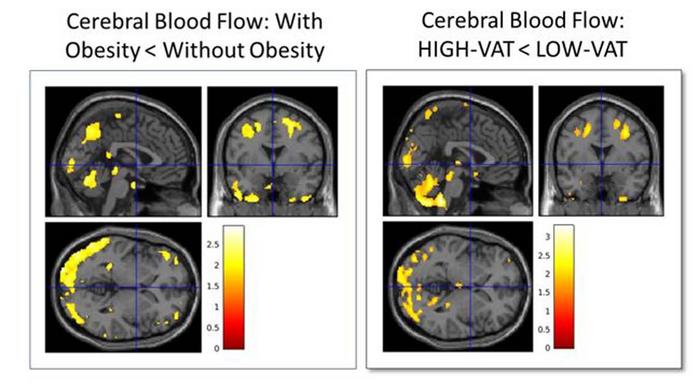
Drs. Raji, Dolatshahi and colleagues are also presenting a study at RSNA 2024 that shows how obesity and visceral fat reduce blood flow in the brain.
In that study, the researchers performed brain and abdominal MRI on cognitively normal midlife individuals with a wide range of BMI and compared whole-brain and regional cerebral blood flow on brain MRI in individuals with high vs. low visceral and subcutaneous fat. The high visceral fat group showed lower whole-brain blood flow. No significant difference was observed in cerebral blood flow in the groups with high vs. low subcutaneous fat.
"This work will have a considerable impact on public health because nearly three out of four Americans are overweight or obese," Dr. Raji said. "Knowing that visceral obesity negatively affects the brain opens up the possibility that treatment with lifestyle modifications or appropriate weight-loss drugs could improve cerebral blood flow and potentially lower the burden of and reduce the risk for Alzheimer's disease."
Other co-authors are Paul K. Commean, B.E.E., Mahshid Naghashzadeh, M.S., Sara Hosseinzadeh Kassani, Ph.D., Jake Weeks, B.S., Caitlyn Nguyen, B.S., Abby McBee-Kemper, B.S., Nancy Hantler, B.S., LaKisha Lloyd, M.Sc., Shaney Flores, M.S., Yifei Xu, M.S., Jingxia Liu, Ph.D., Claude B. Sirlin, M.D., Bettina Mittendorfer, Ph.D., Joseph E. Ippolito, M.D., Ph.D., John C. Morris, M.D., and Tammie L.S. Benzinger, M.D., Ph.D. This study was awarded the RSNA Trainee Research Prize.
"This crucial result was discovered because we investigated Alzheimer's disease pathology as early as midlife -- in the 40s and 50s -- when the disease pathology is at its earliest stages, and potential modifications like weight loss and reducing visceral fat are more effective as a means of preventing or delaying the onset of the disease," said lead study author Mahsa Dolatshahi, M.D., M.P.H., post-doctoral research associate at Mallinckrodt Institute of Radiology (MIR) at Washington University School of Medicine in St. Louis, Missouri.
An estimated 6.9 million Americans, aged 65 and older, are living with Alzheimer's disease, according to the Alzheimer's Association. The association estimates this number could grow to 13 million by 2050, barring the development of medical breakthroughs to prevent or cure the disease.
For the study, the researchers focused on the link between modifiable lifestyle-related factors, such as obesity, body fat distribution and metabolic aspects, and Alzheimer's disease pathology.
A total of 80 cognitively normal midlife individuals (average age: 49.4 years, female: 62.5%,) were included in the study. Approximately 57.5% of participants were obese, and the average body mass index (BMI) of the participants was 32.31. The participants underwent brain positron emission tomography (PET), body MRI and metabolic assessment (glucose and insulin measurements), as well as a lipid (cholesterol) panel. MRI scans of the abdomen were performed to measure the volume of the subcutaneous fat (the fat under skin) and visceral fat (deep hidden fat surrounding the organs).
"We investigated the association of BMI, visceral fat, subcutaneous fat, liver fat fraction, thigh fat and muscle, as well as insulin resistance and HDL (good cholesterol), with amyloid and tau deposition in Alzheimer's disease," said Dr. Dolatshahi, a member of the Raji Lab at MIR's Neuroimaging Labs Research Center.
Thigh muscle scans were used to measure volume of muscle and fat. Alzheimer's disease pathology was measured using PET scans with tracers that bind to amyloid plaques and tau tangles that accumulate in the brains of people with Alzheimer's disease. The findings revealed that higher levels of visceral fat were related to increased amyloid, accounting for 77% of the effect of high BMI on amyloid accumulation. Other types of fat did not explain obesity-related increased Alzheimer's pathology.
"Our study showed that higher visceral fat was associated with higher PET levels of the two hallmark pathologic proteins of Alzheimer's disease -- amyloid and tau," Dr. Dolatshahi said. "To our knowledge, our study is the only one to demonstrate these findings at midlife where our participants are decades out from developing the earliest symptoms of the dementia that results from Alzheimer's disease."
The study also showed that higher insulin resistance and lower HDL were associated with high amyloid in the brain. The effects of visceral fat on amyloid pathology were partially reduced in people with higher HDL.
"A key implication of our work is that managing Alzheimer's risk in obesity will need to involve targeting the related metabolic and lipid issues that often arise with higher body fat," said senior study author Cyrus A. Raji, M.D., Ph.D., associate professor of radiology at MIR.
Although previous studies have shown the role of high BMI in damaging the cells of the brain, no similar study has investigated the differential role of visceral and subcutaneous fat or metabolic profile, especially in terms of Alzheimer's amyloid pathology as early as midlife, Dr. Dolatshahi pointed out.
"This study goes beyond using BMI to characterize body fat more accurately with MRI and, in so doing, reveals key insights about why obesity can increase risk for Alzheimer's disease," Dr. Dolatshahi said.
Drs. Raji, Dolatshahi and colleagues are also presenting a study at RSNA 2024 that shows how obesity and visceral fat reduce blood flow in the brain.
In that study, the researchers performed brain and abdominal MRI on cognitively normal midlife individuals with a wide range of BMI and compared whole-brain and regional cerebral blood flow on brain MRI in individuals with high vs. low visceral and subcutaneous fat. The high visceral fat group showed lower whole-brain blood flow. No significant difference was observed in cerebral blood flow in the groups with high vs. low subcutaneous fat.
"This work will have a considerable impact on public health because nearly three out of four Americans are overweight or obese," Dr. Raji said. "Knowing that visceral obesity negatively affects the brain opens up the possibility that treatment with lifestyle modifications or appropriate weight-loss drugs could improve cerebral blood flow and potentially lower the burden of and reduce the risk for Alzheimer's disease."
Other co-authors are Paul K. Commean, B.E.E., Mahshid Naghashzadeh, M.S., Sara Hosseinzadeh Kassani, Ph.D., Jake Weeks, B.S., Caitlyn Nguyen, B.S., Abby McBee-Kemper, B.S., Nancy Hantler, B.S., LaKisha Lloyd, M.Sc., Shaney Flores, M.S., Yifei Xu, M.S., Jingxia Liu, Ph.D., Claude B. Sirlin, M.D., Bettina Mittendorfer, Ph.D., Joseph E. Ippolito, M.D., Ph.D., John C. Morris, M.D., and Tammie L.S. Benzinger, M.D., Ph.D. This study was awarded the RSNA Trainee Research Prize.

Saturday, January 4, 2020
How to Unlock Your Hidden Creative Genius
This page pulls together my most essential information about creativity. I’ll share how creativity works, how to find your hidden creative genius, and how to create meaningful work by learning how to make creative thinking a habit. I’ve tried to present the basics of everything you need to know to start mastering creativity, even if you don’t have much time.
At the end of this page, you’ll find a complete list of all the articles I have written on creativity.

What is Creativity?
Let's define creativity.
The creative process is the act of making new connections between old ideas or recognizing relationships between concepts. Creative thinking is not about generating something new from a blank slate, but rather about taking what is already present and combining those bits and pieces in a way that has not been done previously.
While being creative isn't easy, nearly all great ideas follow a similar creative process. In 1940, an advertising executive named James Webb Young published a short guide titled, A Technique for Producing Ideas.
Young believed the process of creative connection always occurred in five steps.
The Creative Process
- Gather new material. At first, you learn. During this stage you focus on 1) learning specific material directly related to your task and 2) learning general material by becoming fascinated with a wide range of concepts.
- Thoroughly work over the materials in your mind. During this stage, you examine what you have learned by looking at the facts from different angles and experimenting with fitting various ideas together.
- Step away from the problem. Next, you put the problem completely out of your mind and go do something else that excites you and energizes you.
- Let your idea return to you. At some point, but only after you have stopped thinking about it, your idea will come back to you with a flash of insight and renewed energy.
- Shape and develop your idea based on feedback. For any idea to succeed, you must release it out into the world, submit it to criticism, and adapt it as needed.
Is There Such a Thing as ‘Naturally Creative'?
While we often think of creativity as an event or as a natural skill that some people have and some don't, research actually suggests that both creativity and non-creativity are learned.
According to psychology professor Barbara Kerr, “approximately 22 percent of the variance [in creativity] is due to the influence of genes.” This discovery was made by studying the differences in creative thinking between sets of twins.
All of this to say, claiming that “I'm just not the creative type” is a pretty weak excuse for avoiding creative thinking. Certainly, some people are primed to be more creative than others. However, nearly every person is born with some level of creative skill and the majority of our creative thinking abilities are trainable.
Read more: Creativity Is a Process, Not an Event
3 Lessons on Creativity from Famous Creators
- The 15-Minute Routine Anthony Trollope Used to Write 40+ Books: Beginning with his first novel in 1847, Anthony Trollope wrote at an incredible pace. Over the next 38 years, he published 47 novels, 18 works of non-fiction, 12 short stories, 2 plays, and an assortment of articles and letters. Let’s break down why Trollope's simple strategy allowed the author to be so productive and how we can use it in our own lives.
- The Weird Strategy Dr. Seuss Used to Create His Greatest Work: In 1960, the founder of Random House publishing firm challenged Dr. Seuss to write an entertaining children’s book using only 50 different words. The result was a little book called Green Eggs and Ham. Here's what we can learn from Dr. Seuss…
- How Creative Geniuses Come Up With Great Ideas: Best-selling author Markus Zusak estimated that he rewrote the first part of his popular book “The Book Thief” 150 to 200 times. His work ethic and dedication tell us something crucial about how creative geniuses come up with great ideas.
You can also check out creativity articles about Albert Einstein, Martha Graham, George R.R. Martin, and Maya Angelou.
How to Be Creative
Step 1: Give yourself permission to create junk
In any creative endeavor, you have to give yourself permission to create junk. There is no way around it. Sometimes you have to write 4 terrible pages just to discover that you wrote one good sentence in the second paragraph of the third page.
Creating something useful and compelling is like being a gold miner. You have to sift through pounds of dirt and rock and silt just to find a speck of gold in the middle of it all. Bits and pieces of genius will find their way to you, if you give yourself permission to let the muse flow.
Step 2: Create on a schedule
No single act will uncover more creative genius than forcing yourself to create consistently. Practicing your craft over and over is the only way to become decent at it. The person who sits around theorizing about what a best-selling book looks like will never write it. Meanwhile, the writer who shows up every day and puts their butt in the chair and their hands on the keyboard — they are learning how to do the work.
If you want to do your best creative work, then don't leave it up to choice. Don't wake up in the morning and think, “I hope I feel inspired to create something today.” You need to take the decision-making out of it. Set a schedule for your work. Genius arrives when you show up enough times to get the average ideas out of the way.
Step 3: Finish something
Finish something. Anything. Stop researching, planning, and preparing to do the work and just do the work. It doesn't matter how good or how bad it is. You don't need to set the world on fire with your first try. You just need to prove to yourself that you have what it takes to produce something.
There are no artists, athletes, entrepreneurs, or scientists who became great by half-finishing their work. Stop debating what you should make and just make something.
Step 4: Stop judging your own work
Everyone struggles to create great art. Even great artists.
Anyone who creates something on a consistent basis will begin to judge their own work. I write new articles every Monday and Thursday. After sticking to that publishing schedule for three months, I began to judge everything I created. I was convinced that I had gone through every decent idea I had available. My most popular article came 8 months later.
It is natural to judge your work. It is natural to feel disappointed that your creation isn't as wonderful as you hoped it would be, or that you're not getting any better at your craft. But the key is to not let your discontent prevent you from continuing to do the work.
You have to practice enough self-compassion to not let self-judgement take over. Sure, you care about your work, but don't get so serious about it that you can't laugh off your mistakes and continue to produce the thing you love. Don't let judgment prevent delivery.
Step 5: Hold yourself accountable
Share your work publicly. It will hold you accountable to creating your best work. It will provide feedback for doing better work. And when you see others connect with what you create, it will inspire you and make you care more.
Sometimes sharing your work means you have to deal with haters and critics. But more often than not, the only thing that happens is that you rally the people who believe the same things you believe, are excited about the same things you are excited about, or who support the work that you believe in — who wouldn't want that?
The world needs people who put creative work out into the world. What seems simple to you is often brilliant to someone else. But you'll never know that unless you choose to share.
How to Find Your Creative Genius
Finding your creative genius is easy: do the work, finish something, get feedback, find ways to improve, show up again tomorrow. Repeat for ten years. Or twenty. Or thirty.
Inspiration only reveals itself after perspiration.
Wednesday, January 1, 2020
How to Unlock Your Hidden Creative Genius
This page pulls together my most essential information about creativity. I’ll share how creativity works, how to find your hidden creative genius, and how to create meaningful work by learning how to make creative thinking a habit. I’ve tried to present the basics of everything you need to know to start mastering creativity, even if you don’t have much time.
At the end of this page, you’ll find a complete list of all the articles I have written on creativity.

What is Creativity?
Let's define creativity.
The creative process is the act of making new connections between old ideas or recognizing relationships between concepts. Creative thinking is not about generating something new from a blank slate, but rather about taking what is already present and combining those bits and pieces in a way that has not been done previously.
While being creative isn't easy, nearly all great ideas follow a similar creative process. In 1940, an advertising executive named James Webb Young published a short guide titled, A Technique for Producing Ideas.
Young believed the process of creative connection always occurred in five steps.
The Creative Process
- Gather new material. At first, you learn. During this stage you focus on 1) learning specific material directly related to your task and 2) learning general material by becoming fascinated with a wide range of concepts.
- Thoroughly work over the materials in your mind. During this stage, you examine what you have learned by looking at the facts from different angles and experimenting with fitting various ideas together.
- Step away from the problem. Next, you put the problem completely out of your mind and go do something else that excites you and energizes you.
- Let your idea return to you. At some point, but only after you have stopped thinking about it, your idea will come back to you with a flash of insight and renewed energy.
- Shape and develop your idea based on feedback. For any idea to succeed, you must release it out into the world, submit it to criticism, and adapt it as needed.
Subscribe to:
Posts (Atom)