Showing posts with label best. Show all posts
Showing posts with label best. Show all posts
Saturday, January 23, 2021
best coffee machine for home india
Best Coffee Machines in India
1. Morphy Richards New Europa 800-Watt Espresso and Cappuccino 4-Cup Coffee Maker
Check Price at Amazon
This is one efficient appliance that helps you get your caffeine fix anytime. It puts your professional grade espresso or cappuccino within your stride in minutes.
Morphy Richards New Europa 800-Watt Espresso and Cappuccino 4-Cup Coffee Maker
Built & Design
Makes cappuccino, latte, and espresso
Good for up to 4 cups
2-year warranty
Power: 800 watts; operating voltage: 230 volts
Performance: Morphy Richards New Europa 800-Watt Espresso and Cappuccino 4-Cup Coffee Maker is all that you need at your home. This machine is a multi-tasker that get you coffee as you like it. You can use any blend you like. It has a mean motor but lacks proper space for water to get in so you may need a manual pressing.
Pros
Anti -slip base so that you don’t have to worry about a kitchen slip.
Heat resistant glass carafe so there are no blow ups.
Non slip grip. So that you don’t break your carafe.
Easy to clean
Neon light Indicator
800 W Motor
Cons
Water Indicator is missing
2. InstaCuppa French Press Coffee Espresso Tea Maker
Check Price at Amazon
If you want best morning coffee, espresso you need this. It is one of the best budget coffee makers available. It could serve six cups of coffee in one go. So, no more refilling and waiting for the coffee you are craving for.
InstaCuppa French Press Coffee Espresso Tea Maker
Built & Design
Stainless steel body which gives it a rugged exterior
Elegant and stylish design
FDA approved
600 ml capacity
Performance: This is by far the most budget friendly machine on offer. Easy to use and hassle free. It is a great apparatus for someone starting anew.
Pros
Plunger mechanism is smooth and easy to use.
Dishwasher safe
Borosilicate glass and steel exoskeleton makes it durable
Can make 6 cups in a brew.
Elegant design
Can also be used to brew tea.
Cons
Coffee beans need to be pre ground.
You need to keep track of brew time; else you get bitter tasting coffee.
3. Philips Daily Collection HD7434/20 0.92-Litre Coffee Maker
Check Price at Amazon
Philips is the go to brands in home appliance space. It is trusted by buyers across generations. The Philips HD7431/20 0.92 Coffee Maker (Black/Metal) is an efficient drip coffee maker with some unique features. The design and styling of the machine is pleasing to the eyes.
Philips Daily Collection HD7434/20 0.92-Litre Coffee Maker
Built & Design
AromaSwirl for optimal aroma distribution
Drip brewing
Capacity of 0.92 Litres
Total Brewing time approx. 10 minutes
Power by a 700 watt motor and works with 230 volt supply
2-year Warranty
Performance: The Philips HD7431/20 0.92 Coffee Maker (Black/Metal) is perfect for making drip coffee and can make 4 to 5 cups in one go. It makes sure that you get consistent quality brew every single time. The coffee flask is detachable which makes cleaning it effortless.
Pros
Lightweight ergonomic design
Elegant and stylish
Friendly to the Pocket
Easy to use.
Dishwasher safe
Cons
It gets quite noisy at the end of the brewing process.
The Brew may feel watery; add enough coffee for better results.
4. Preethi Cafe Zest Drip Coffee Maker
Check Price at Amazon
Preethi Cafe Zest Drip Coffee Maker (CM210) is a great coffee machine to prepare café grade coffee at home. It is packed with a powerful heater that helps expedite the brewing process. It also has a nifty look.
Preethi Cafe Zest CM210 Drip Coffee Maker
Built & Design
Water level indicator
Anti-drip system
Heat sensitive shock proof ABS body.
Power: 450 watts; operating voltage: 230 volts
1 Year Warranty
Designer Handle
Performance: Preethi Cafe Zest Drip Coffee Maker (CM210 is a compact machine with a powerful motor that delivers great tasting coffee. This Desi brand is not only efficient but has invested in your safety as it comes with ABS shock proof plastic body. It is just the appliance for household brewing adventure.
Pros
Friendly to your pocket
Available in a wide range of colors
Shockproof ABS body
Cons
Average built quality
5. Prestige PCMD 1.0 650-Watt Espresso Coffee Maker
Check Price at Amazon
Prestige Drip coffee maker is for the lovers of South Indian filter coffee .It makes great coffee with advance mesh filter , anti-drip mechanism , advanced brewing technology , water level indicator etc. ,you can enjoy the perfect cup of coffee at the comfort of your home , any time , any day .
Prestige PCMD 1.0 650-Watt Espresso Coffee Maker
Built & Design
Advanced mesh filter
Elegant and stylish design
Anti-drip mechanism
Water level indicator
FDA approved
Power: 650 watts; operating voltage: 230 volts
1 Year Warranty
Performance: Prestige is a brand that you can trust and this offering from the house of prestige doesnot disappoint. The company understands India’s love affair with filter coffee and this machine delivers on that front spectacularly.
Pros
Nifty design.
Easy to use and clean
Anti-drip valve prevents dripping when the carafe is removed
Steam vent for releasing excess steam.
Water level indicator
Cons
Temperature control unavailable
Makes noise due to lack of water towards the end of the brewing process.
6. Philips HD7431/20 Coffee Maker
Check Price at Amazon
Philips is the go to brands in home appliance space. It is trusted by buyers across generations. The Philips HD7431/20 Coffee Maker (Black) is an efficient drip coffee maker with some unique features. The design and styling of the machine is pleasing to the eyes.
Philips HD7431
Built & Design
Hassle-free cleaning
Drip brewing
Capacity of 0.6 Liters
Total Brewing time approx. 10 minutes
Power by a 700 watt motor and works with 230 volt supply
2-year Warranty
Performance: The Philips HD7431/20 Coffee Maker (Black) is perfect for making drip coffee and can make 3-4 cups in one go. It makes sure that you get consistent quality brew every single time. The coffee flask is detachable which makes cleaning it effortless.
Pros
Lightweight ergonomic design
Elegant and stylish
Friendly to the Pocket
Easy to use.
Cons
It gets quite noisy at the end of the brewing process.
The Brew may feel watery; add enough coffee for better results.
7. Morphy Richards Fresco 800-Watt 4-Cups Espresso Coffee Maker
Check Price at Amazon
Morphy Richards Fresco 800-Watt 4-Cups Espresso Coffee Maker is a delight for Espresso aficionados, Make delicious espressos for you and your family in a snap. And get the feel of a Starbucks espress at home. It will also look brilliant in your lovely kitchen.
Morphy Richards Fresco 800-Watt 4-Cups Espresso Coffee Maker
Built & Design
Can make 4 cups with milk frothing
Heat resistant with drip tray, so that you worry less about dropping your precious cuppa.
The see through glass carafe to relish your brew.
Temperature indicator.
2-year warranty.
Power: 800 watts; operating voltage: 210-250 volts
Performance: The Morphy Richards Fresco 800-Watt 4-Cups Espresso Coffee Maker is for people who like their CCDs and Starbucks espresso with cream on top. Now you don’t need to wait for ages to quench your thirst for espressos. It is a boon for all coffee addicts. Get your coffee fix anytime you feel like.
Pros
It is elegant and modern in style
Professional grade espresso
Makes 4-6 cups at a time
The milk froth is thick and airy
The drip tray makes the machine-accessible
Friendly to your pocket
Cons
You can’t control the temperature
Machine not big enough for frothing you need some jugaad. Use a cup instead
How to brew the ultimate drink
What is the best temperature to brew coffee?
The optimal water temperature for drip coffee is 95-98C. water below this temperature doesn’t extract enough caffeine/essential oils from the beans, and above such temperature the acidity increases wildly.
Quality of coffee
The quality of a brew depends on many factors few are noted below:
Time elapsed since the bean is ground (fresher the better).
Time elapsed since roasting (again you want is as fresh as you can).
Clean brewing equipment, so that you don’t get any residue taste.
Quality of your coffee bean.
Quality of the water used for brewing.
What is the difference between Arabica and Robusta?
Arabica and Robusta are two different species of coffee. Almost all the world’s coffee is of one or the other type. The differences are those of taste and conditions of their individual growing patterns.
Taste: Arabicas have a wider taste range, between varieties. They range in taste from sweet-soft to sharp-tangy. Their unroasted smell is sometimes likened to blueberries. Their roasted smell is perfumey with fruity notes and sugary tones.
Robustas taste range is neutral to harsh and they are often described as tasting grain-like, oatmeally. Their unroasted smell is often described as raw-peanut. Their roasted smell is often likened to burnt rubber.
Production Conditions: Arabicas are delicate; they require cool tropical climates, lots of moisture, rich soil, shade and sun. They are subject to attack from various pests, and are extremely vulnerable to cold and bad handling.
Robustas are hardier plants, capable of growing well at low altitudes, less subject to problems related to pests and rough handling. They yield more pounds of finished goods per acre at a lower cost of production.
You can read the full difference between Arabica and Robusta here.
Just how much ground coffee do I need for x amount of coffee?
Whatever seems right to you.
It may change slightly from coffee to coffee and according to freshness.
My personal taste is 1 tablespoon per cup of coffee
How to select your coffee machine
coffee machine india
1. Bang for the buck
It is important that while buying any home appliance you get the most for what you pay. Also, all available products may not fall under your budget.
You should always decide in advance your requirements and then chose the appliance that is efficient as well as budget friendly. Here you may find two products with the same features but different price points. Choose the one that gives you most utility.
2. Ease of Use
The coffee maker is easy to use does not involve any rocket science. You need to follow certain steps and the rest is done automatically. Some machines come with a timer that lets you know when the coffee is ready using an alarm all you to do is fill the machine up and wait for it to beep
3.The Output
It is very important that you know the amount of coffee you will need in one go.
Single Cup Coffee Maker
This coffee maker can crank up a single cup at one go and is just perfect for a smaller family where people drink coffee at different times.
Multi Cup Coffee Maker
This coffee maker can prepare about 3-4 cups of coffee at a time and is for those who like to have their coffee with friends and company.
4. Category
Indians usually prefer milk in their coffee so latte, cappuccino are often the go-to choices, there is also a growing trend of black coffee drinkers, so we see all this rage about the espresso coffee and hence it is important to identify your preference while shopping.
You have a wide range of options there are coffee makers that can do all kinds of coffee and there are some which specialize in one or the other form. Always make sure that you research well into your taste and preferences before making the buy.
5. Safety
If an appliance needs the power to run, it is imminent that it has shock proofing mechanisms. Your safety should be of utmost priority. In case of overload, the circuit breaks and the appliance stops working. This factor should never be neglected as overload could lead to chances of shock.
6. Stress-free maintenance
Coffee maker jars are generally detachable which make them easy to clean and maintain. Always factor the ease of use and cleaning while researching the product. As difficulty while cleaning will prevent you from using your appliance less often.

Saturday, July 11, 2020
The best (and worst) materials for masks

The best (and worst) materials for masks
It's intuitive and scientifically shown that wearing a face covering can help reduce the spread of the novel coronavirus that causes COVID-19. But not all masks are created equal, according to new University of Arizona-led research.
Amanda Wilson, an environmental health sciences doctoral candidate in the Department of Community, Environment and Policy in the Mel and Enid Zuckerman College of Public Health, is lead author on a recent study published in the Journal of Hospital Infection that assessed the ability of a variety of nontraditional mask materials to protect a person from infection after 30 seconds and after 20 minutes of exposure in a highly contaminated environment.
When the researchers compared wearing masks to wearing no protection during 20-minute and 30-second exposures to the virus, they found that infection risks were reduced by 24-94% or by 44-99% depending on the mask and exposure duration. Risk reduction decreased as exposure duration increased, they found.
"N99 masks, which are even more efficient at filtering airborne particles than N95 masks, are obviously one of the best options for blocking the virus, as they can reduce average risk by 94-99% for 20-minute and 30-second exposures, but they can be hard to come by, and there are ethical considerations such as leaving those available for medical professionals," Wilson said.
The next best options, according to the research, are N95 and surgical masks and, perhaps surprisingly, vacuum cleaner filters, which can be inserted into filter pockets in cloth masks. The vacuum filters reduced infection risk by 83% for a 30-second exposure and 58% for a 20-minute exposure. Of the other nontraditional materials evaluated by the researchers, tea towels, cotton-blend fabrics and antimicrobial pillowcases were the next best for protection.
Scarves, which reduced infection risk by 44% after 30 seconds and 24% after 20 minutes, and similarly effective cotton t-shirts are only slightly better than wearing no mask at all, they found.
"We knew that masks work, but we wanted to know how well and compare different materials' effects on health outcomes," said Wilson, who specializes in quantitative microbial risk assessment.
Wilson and her team collected data from various studies of mask efficacy and created a computer model to simulate infection risk, taking various factors into consideration.
"One big component of risk is how long you're exposed. We compared risk of infection at both 30 seconds and 20 minutes in a highly contaminated environment," she said.
Other conditions that impact risk of infection are the number of people around you and their distance from you, she said.
The size of virus-transporting droplets from sneezes, coughs or even speech is also a very important factor. Larger, heavier droplets carrying the virus drop out of the air faster than smaller, lighter ones. That's one reason distance helps reduce exposure.
"Aerosol size can also be affected by humidity," Wilson said. "If the air is drier, then aerosols become smaller faster. If humidity is higher, then aerosols will stay larger for a longer period of time, dropping out faster. That might sound good at first, but then those aerosols fall on surfaces, and that object becomes another potential exposure route."
The study also showed that the more time a person spends in an environment where the virus is present, the less effective a mask becomes.
"That doesn't mean take your mask off after 20 minutes," Wilson said, "but it does mean that a mask can't reduce your risk to zero. Don't go to a bar for four hours and think you're risk free because you're wearing a mask. Stay home as much as possible, wash your hands often, wear a mask when you're out and don't touch your face."
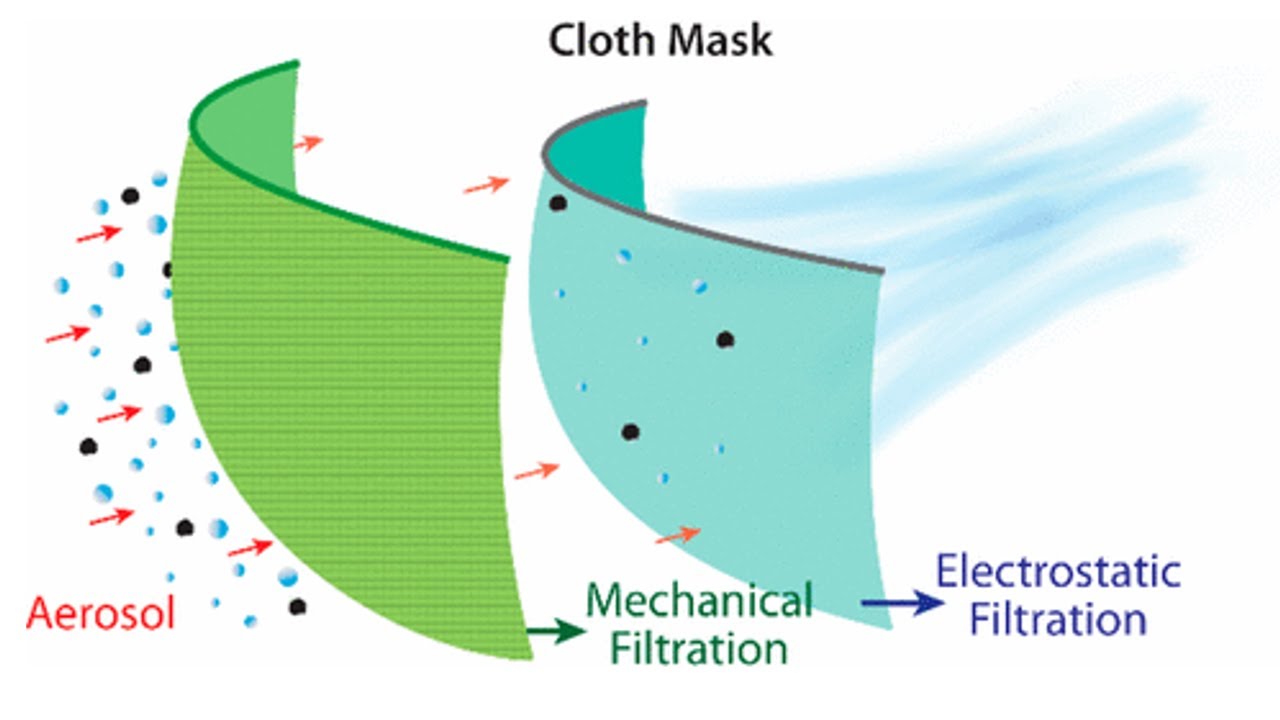
Masks protect the wearer and others in a number of different ways. Wilson said there are two "intuitive ways" that masks filter larger aerosols: mechanical interception and inertial impaction.
"The denser the fibers of a material, the better it is at filtering. That's why higher thread counts lead to higher efficacy. There's just more to block the virus," she said. "But some masks (such as those made from silk) also have electrostatic properties, which can attract smaller particles and keep them from passing through the mask as well."
The model developed by Wilson and her colleagues included parameters such as inhalation rate -- the volume of air inhaled over time -- and virus concentration in the air.
"We took a lot of research data, put it into a mathematical model and related those data points to each other," Wilson said. "For example, if we know people's inhalation rates vary by this much and know this much virus is in the air and these materials offer this much efficiency in terms of filtration, what does that mean for infection risk? We provide a range, in part, because everyone is different, such as in how much air we breathe over time."
Wilson also said it's important for a mask to have a good seal that pinches at nose, and she noted that people shouldn't wear a mask beneath the nose or tuck it under the chin when not in use.
"Proper use of masks is so important," Wilson said. "Also, we were focusing on masks protecting the wearer, but they're most important to protect others around you if you're infected. If you put less virus out into the air, you're creating a less contaminated environment around you. As our model shows, the amount of infectious virus you're exposed to has a big impact on your infection risk and the potential for others' masks to protect them as well."
Story Source:
Materials provided by University of Arizona. Original written by Mikayla Mace. Note: Content may be edited for style and length.
Journal Reference:
- Amanda M. Wilson, Sarah E. Abney, Marco-Felipe King, Mark H. Weir, Martín López-García, Jonathan D. Sexton, Stephanie J. Dancer, Jessica Proctor, Catherine J. Noakes, Kelly A. Reynolds. COVID-19 and non-traditional mask use: How do various materials compare in reducing the infection risk for mask wearers? Journal of Hospital Infection, 2020; DOI: 10.1016/j.jhin.2020.05.036
The best material for homemade face masks may be a combination of two fabrics
The best material for homemade face masks
In the wake of the COVID-19 pandemic, the U.S. Centers for Disease Control and Prevention recommends that people wear masks in public. Because N95 and surgical masks are scarce and should be reserved for health care workers, many people are making their own coverings. Now, researchers report in ACS Nano that a combination of cotton with natural silk or chiffon can effectively filter out aerosol particles -- if the fit is good.
SARS-CoV-2, the new coronavirus that causes COVID-19, is thought to spread mainly through respiratory droplets when an infected person coughs, sneezes, speaks or breathes. These droplets form in a wide range of sizes, but the tiniest ones, called aerosols, can easily slip through the openings between certain cloth fibers, leading some people to question whether cloth masks can actually help prevent disease. Therefore, Supratik Guha at the University of Chicago and colleagues wanted to study the ability of common fabrics, alone or in combination, to filter out aerosols similar in size to respiratory droplets.
The researchers used an aerosol mixing chamber to produce particles ranging from 10 nm to 6 μm in diameter. A fan blew the aerosol across various cloth samples at an airflow rate corresponding to a person's respiration at rest, and the team measured the number and size of particles in air before and after passing through the fabric. One layer of a tightly woven cotton sheet combined with two layers of polyester-spandex chiffon -- a sheer fabric often used in evening gowns -- filtered out the most aerosol particles (80-99%, depending on particle size), with performance close to that of an N95 mask material. Substituting the chiffon with natural silk or flannel, or simply using a cotton quilt with cotton-polyester batting, produced similar results. The researchers point out that tightly woven fabrics, such as cotton, can act as a mechanical barrier to particles, whereas fabrics that hold a static charge, like certain types of chiffon and natural silk, serve as an electrostatic barrier. However, a 1% gap reduced the filtering efficiency of all masks by half or more, emphasizing the importance of a properly fitted mask.
The authors acknowledge use of the U.S. Department of Energy's Center for Nanoscale Materials user facility at Argonne National Laboratory and funding from the U.S. Department of Defense's Vannevar Bush Fellowship.
Story Source:
Materials provided by American Chemical Society. Note: Content may be edited for style and length.
Journal Reference:
- Abhiteja Konda, Abhinav Prakash, Gregory A. Moss, Michael Schmoldt, Gregory D. Grant, Supratik Guha. Aerosol Filtration Efficiency of Common Fabrics Used in Respiratory Cloth Masks. ACS Nano, 2020; DOI: 10.1021/acsnano.0c03252
Friday, November 30, 2018


Thursday, November 29, 2018


Subscribe to:
Posts (Atom)