New ads.

Showing posts with label masks. Show all posts

Saturday, July 11, 2020

The best (and worst) materials for masks

The best (and worst) materials for masks

It's intuitive and scientifically shown that wearing a face covering can help reduce the spread of the novel coronavirus that causes COVID-19. But not all masks are created equal, according to new University of Arizona-led research.
Amanda Wilson, an environmental health sciences doctoral candidate in the Department of Community, Environment and Policy in the Mel and Enid Zuckerman College of Public Health, is lead author on a recent study published in the Journal of Hospital Infection that assessed the ability of a variety of nontraditional mask materials to protect a person from infection after 30 seconds and after 20 minutes of exposure in a highly contaminated environment.
When the researchers compared wearing masks to wearing no protection during 20-minute and 30-second exposures to the virus, they found that infection risks were reduced by 24-94% or by 44-99% depending on the mask and exposure duration. Risk reduction decreased as exposure duration increased, they found.
"N99 masks, which are even more efficient at filtering airborne particles than N95 masks, are obviously one of the best options for blocking the virus, as they can reduce average risk by 94-99% for 20-minute and 30-second exposures, but they can be hard to come by, and there are ethical considerations such as leaving those available for medical professionals," Wilson said.
The next best options, according to the research, are N95 and surgical masks and, perhaps surprisingly, vacuum cleaner filters, which can be inserted into filter pockets in cloth masks. The vacuum filters reduced infection risk by 83% for a 30-second exposure and 58% for a 20-minute exposure. Of the other nontraditional materials evaluated by the researchers, tea towels, cotton-blend fabrics and antimicrobial pillowcases were the next best for protection.
Scarves, which reduced infection risk by 44% after 30 seconds and 24% after 20 minutes, and similarly effective cotton t-shirts are only slightly better than wearing no mask at all, they found.
"We knew that masks work, but we wanted to know how well and compare different materials' effects on health outcomes," said Wilson, who specializes in quantitative microbial risk assessment.
Wilson and her team collected data from various studies of mask efficacy and created a computer model to simulate infection risk, taking various factors into consideration.
"One big component of risk is how long you're exposed. We compared risk of infection at both 30 seconds and 20 minutes in a highly contaminated environment," she said.
Other conditions that impact risk of infection are the number of people around you and their distance from you, she said.
The size of virus-transporting droplets from sneezes, coughs or even speech is also a very important factor. Larger, heavier droplets carrying the virus drop out of the air faster than smaller, lighter ones. That's one reason distance helps reduce exposure.
"Aerosol size can also be affected by humidity," Wilson said. "If the air is drier, then aerosols become smaller faster. If humidity is higher, then aerosols will stay larger for a longer period of time, dropping out faster. That might sound good at first, but then those aerosols fall on surfaces, and that object becomes another potential exposure route."
The study also showed that the more time a person spends in an environment where the virus is present, the less effective a mask becomes.
"That doesn't mean take your mask off after 20 minutes," Wilson said, "but it does mean that a mask can't reduce your risk to zero. Don't go to a bar for four hours and think you're risk free because you're wearing a mask. Stay home as much as possible, wash your hands often, wear a mask when you're out and don't touch your face."
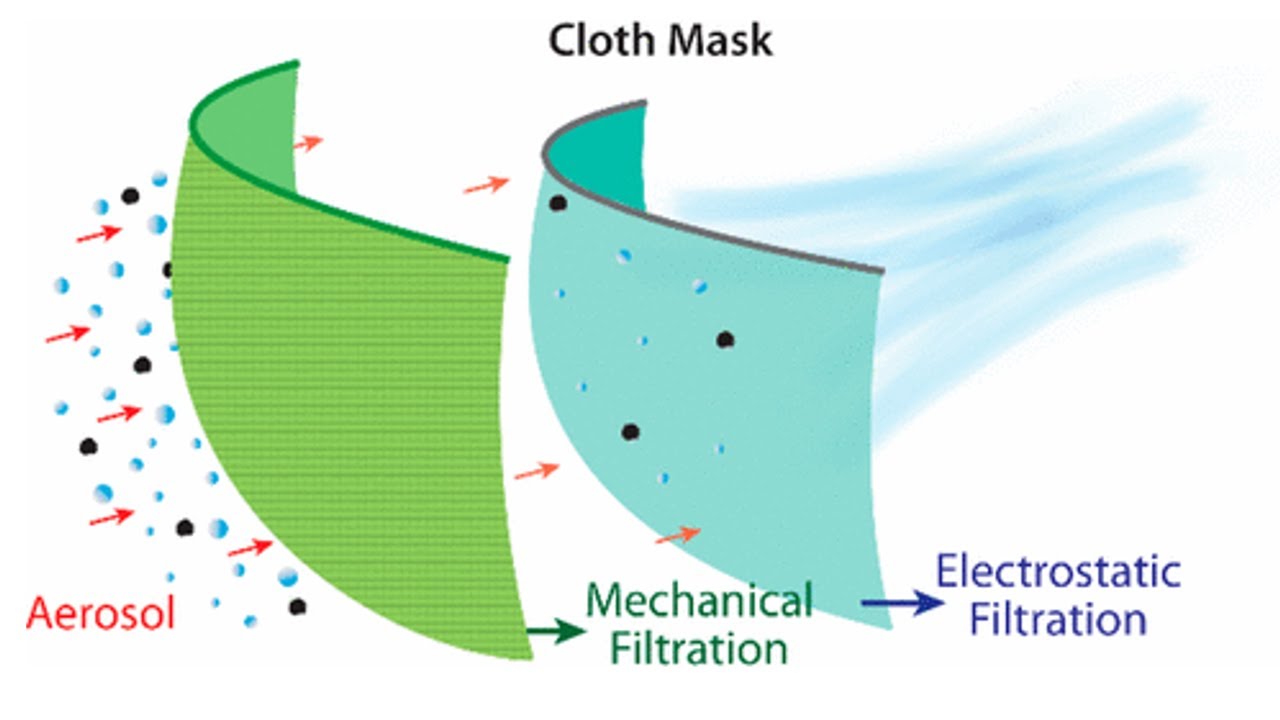
Masks protect the wearer and others in a number of different ways. Wilson said there are two "intuitive ways" that masks filter larger aerosols: mechanical interception and inertial impaction.
"The denser the fibers of a material, the better it is at filtering. That's why higher thread counts lead to higher efficacy. There's just more to block the virus," she said. "But some masks (such as those made from silk) also have electrostatic properties, which can attract smaller particles and keep them from passing through the mask as well."
The model developed by Wilson and her colleagues included parameters such as inhalation rate -- the volume of air inhaled over time -- and virus concentration in the air.
"We took a lot of research data, put it into a mathematical model and related those data points to each other," Wilson said. "For example, if we know people's inhalation rates vary by this much and know this much virus is in the air and these materials offer this much efficiency in terms of filtration, what does that mean for infection risk? We provide a range, in part, because everyone is different, such as in how much air we breathe over time."
Wilson also said it's important for a mask to have a good seal that pinches at nose, and she noted that people shouldn't wear a mask beneath the nose or tuck it under the chin when not in use.
"Proper use of masks is so important," Wilson said. "Also, we were focusing on masks protecting the wearer, but they're most important to protect others around you if you're infected. If you put less virus out into the air, you're creating a less contaminated environment around you. As our model shows, the amount of infectious virus you're exposed to has a big impact on your infection risk and the potential for others' masks to protect them as well."

Story Source:
Materials provided by University of Arizona. Original written by Mikayla Mace. Note: Content may be edited for style and length.

Journal Reference:
  1. Amanda M. Wilson, Sarah E. Abney, Marco-Felipe King, Mark H. Weir, Martín López-García, Jonathan D. Sexton, Stephanie J. Dancer, Jessica Proctor, Catherine J. Noakes, Kelly A. Reynolds. COVID-19 and non-traditional mask use: How do various materials compare in reducing the infection risk for mask wearers? Journal of Hospital Infection, 2020; DOI: 10.1016/j.jhin.2020.05.036


The best material for homemade face masks may be a combination of two fabrics

The best material for homemade face masks

In the wake of the COVID-19 pandemic, the U.S. Centers for Disease Control and Prevention recommends that people wear masks in public. Because N95 and surgical masks are scarce and should be reserved for health care workers, many people are making their own coverings. Now, researchers report in ACS Nano that a combination of cotton with natural silk or chiffon can effectively filter out aerosol particles -- if the fit is good.
SARS-CoV-2, the new coronavirus that causes COVID-19, is thought to spread mainly through respiratory droplets when an infected person coughs, sneezes, speaks or breathes. These droplets form in a wide range of sizes, but the tiniest ones, called aerosols, can easily slip through the openings between certain cloth fibers, leading some people to question whether cloth masks can actually help prevent disease. Therefore, Supratik Guha at the University of Chicago and colleagues wanted to study the ability of common fabrics, alone or in combination, to filter out aerosols similar in size to respiratory droplets.
The researchers used an aerosol mixing chamber to produce particles ranging from 10 nm to 6 μm in diameter. A fan blew the aerosol across various cloth samples at an airflow rate corresponding to a person's respiration at rest, and the team measured the number and size of particles in air before and after passing through the fabric. One layer of a tightly woven cotton sheet combined with two layers of polyester-spandex chiffon -- a sheer fabric often used in evening gowns -- filtered out the most aerosol particles (80-99%, depending on particle size), with performance close to that of an N95 mask material. Substituting the chiffon with natural silk or flannel, or simply using a cotton quilt with cotton-polyester batting, produced similar results. The researchers point out that tightly woven fabrics, such as cotton, can act as a mechanical barrier to particles, whereas fabrics that hold a static charge, like certain types of chiffon and natural silk, serve as an electrostatic barrier. However, a 1% gap reduced the filtering efficiency of all masks by half or more, emphasizing the importance of a properly fitted mask.
The authors acknowledge use of the U.S. Department of Energy's Center for Nanoscale Materials user facility at Argonne National Laboratory and funding from the U.S. Department of Defense's Vannevar Bush Fellowship.

Story Source:
Materials provided by American Chemical SocietyNote: Content may be edited for style and length.

Journal Reference:
  1. Abhiteja Konda, Abhinav Prakash, Gregory A. Moss, Michael Schmoldt, Gregory D. Grant, Supratik Guha. Aerosol Filtration Efficiency of Common Fabrics Used in Respiratory Cloth MasksACS Nano, 2020; DOI: 10.1021/acsnano.0c03252

Wednesday, May 20, 2020

Wearing surgical masks in public could help slow COVID-19 pandemic's advance

Wearing surgical masks in public could help slow COVID-19 pandemic's advance


Surgical masks may help prevent infected people from making others sick with seasonal viruses, including coronaviruses, according to new research that could help settle a fierce debate spanning clinical and cultural norms.
In laboratory experiments, the masks significantly reduced the amounts of various airborne viruses coming from infected patients, measured using the breath-capturing "Gesundheit II machine" developed by Dr. Don Milton, a professor of applied environmental health and a senior author of the study published April 3 in the journal Nature Medicine.
Milton has already conferred with federal and White House health officials on the findings, which closely follow statements this week from the head of the Centers for Disease Control and Prevention saying the agency was reconsidering oft-stated advice that surgical masks aren't a useful precaution outside of medical settings. (The debate takes place at a time when clinicians themselves face dangerously inadequate supplies of masks -- a shortfall other UMD researchers are scrambling to help solve.)
The question of masks has roiled society as well, with some retailers refusing to let employees wear them for fear of sending negative signals to customers, and cases of slurs and even physical attacks in the United States and elsewhere against Asians or Asian Americans who were wearing masks, a measure some consider a necessity during a disease outbreak.
The study, conducted prior to the current pandemic with a student of Milton's colleagues on the Faculty of Medicine at the University of Hong Kong, does not address the question of whether surgical masks protect wearers from infection. It does suggest that masks may limit how much the infected -- who in the case of the novel coronavirus often don't have symptoms -- spread diseases including influenza, rhinoviruses and coronaviruses.
Milton, who runs the Public Health Aerobiology, Virology, and Exhaled Biomarker Laboratory in the School of Public Health, demonstrated in a 2013 study that surgical masks could help limit flu transmission. However, he cautions that the effect may not be as great outside of controlled settings.
Nevertheless, he said, the chance they could help justifies taking a new look at whether all people should be encouraged to wear them when they venture out of their houses to stores or other populated locations during the current COVID-19 lockdown.
"In normal times we'd say that if it wasn't shown statistically significant or the effective in real-world studies, we don't recommend it," he said. "But in the middle of a pandemic, we're desperate. The thinking is that even if it cuts down transmission a little bit, it's worth trying."
Previous studies have shown that coronavirus and other respiratory infections are mostly spread during close contact, which has been interpreted by some infectious disease specialists to mean that the disease could spread only through contact and large droplets, such as from a cough or sneeze -- a message that has often been shared with the public.
"What they don't understand is that is merely a hypothesis," Milton said. The current study (along with earlier ones) shows, by contrast, that tiny, aerosolized droplets can indeed diffuse through the air. That means it may be possible to contract COVID-19 not only by being coughed on, but by simply inhaling the breath of someone nearby who has it, whether they have symptoms or not. Surgical masks, however, catch a lot of the aerosolized virus as it's exhaled, he said.
The study was conducted at the University of Hong Kong as part of the dissertation research of the lead author, Dr. Nancy Leung, who, under the supervision of the co-senior authors Drs. Cowling and Milton, recruited 246 people with suspected respiratory viral infections. Milton's Gesundheit machine compared how much virus they exhaled with and without a surgical mask.
"In 111 people infected by either coronavirus, influenza virus or rhinovirus, masks reduced detectable virus in respiratory droplets and aerosols for seasonal coronaviruses, and in respiratory droplets for influenza virus," Leung said. "In contrast, masks did not reduce the emission of rhinoviruses."
Although the experiment took place before the current pandemic, COVID-19 and seasonal coronaviruses are closely related and may be of similar particle size. The report's other senior author, Professor Benjamin Cowling, division head of epidemiology and biostatistics, School of Public Health, HKUMed, and co-director of the World Health Organization Collaborating Centre for Infectious Disease Epidemiology and Control, said, "The ability of surgical masks to reduce seasonal coronavirus in respiratory droplets and aerosols implies that such masks can contribute to slowing the spread of (COVID-19) when worn by infected people."
Milton pointed to other measures his research has found is even more effective than masks, such as improving ventilation in public places like grocery stores, or installing UV-C lights near the ceiling that works in conjunction with ceiling fans to pull air upwards and destroy viruses and bacteria.
"Personal protective equipment like N95 masks are not our first line of defense," Milton said. "They are our last desperate thing that we do."
Hong Kong University contributed to this report.

Story Source:
Materials provided by University of Maryland. Original written by Chris Carroll. Note: Content may be edited for style and length.

Journal Reference:
  1. Nancy H. L. Leung, Daniel K. W. Chu, Eunice Y. C. Shiu, Kwok-Hung Chan, James J. McDevitt, Benien J. P. Hau, Hui-Ling Yen, Yuguo Li, Dennis K. M. Ip, J. S. Malik Peiris, Wing-Hong Seto, Gabriel M. Leung, Donald K. Milton, Benjamin J. Cowling. Respiratory virus shedding in exhaled breath and efficacy of face masksNature Medicine, 2020; DOI: 10.1038/s41591-020-0843-2