New ads.

Showing posts with label Material. Show all posts

Saturday, July 11, 2020

The best material for homemade face masks may be a combination of two fabrics

The best material for homemade face masks

In the wake of the COVID-19 pandemic, the U.S. Centers for Disease Control and Prevention recommends that people wear masks in public. Because N95 and surgical masks are scarce and should be reserved for health care workers, many people are making their own coverings. Now, researchers report in ACS Nano that a combination of cotton with natural silk or chiffon can effectively filter out aerosol particles -- if the fit is good.
SARS-CoV-2, the new coronavirus that causes COVID-19, is thought to spread mainly through respiratory droplets when an infected person coughs, sneezes, speaks or breathes. These droplets form in a wide range of sizes, but the tiniest ones, called aerosols, can easily slip through the openings between certain cloth fibers, leading some people to question whether cloth masks can actually help prevent disease. Therefore, Supratik Guha at the University of Chicago and colleagues wanted to study the ability of common fabrics, alone or in combination, to filter out aerosols similar in size to respiratory droplets.
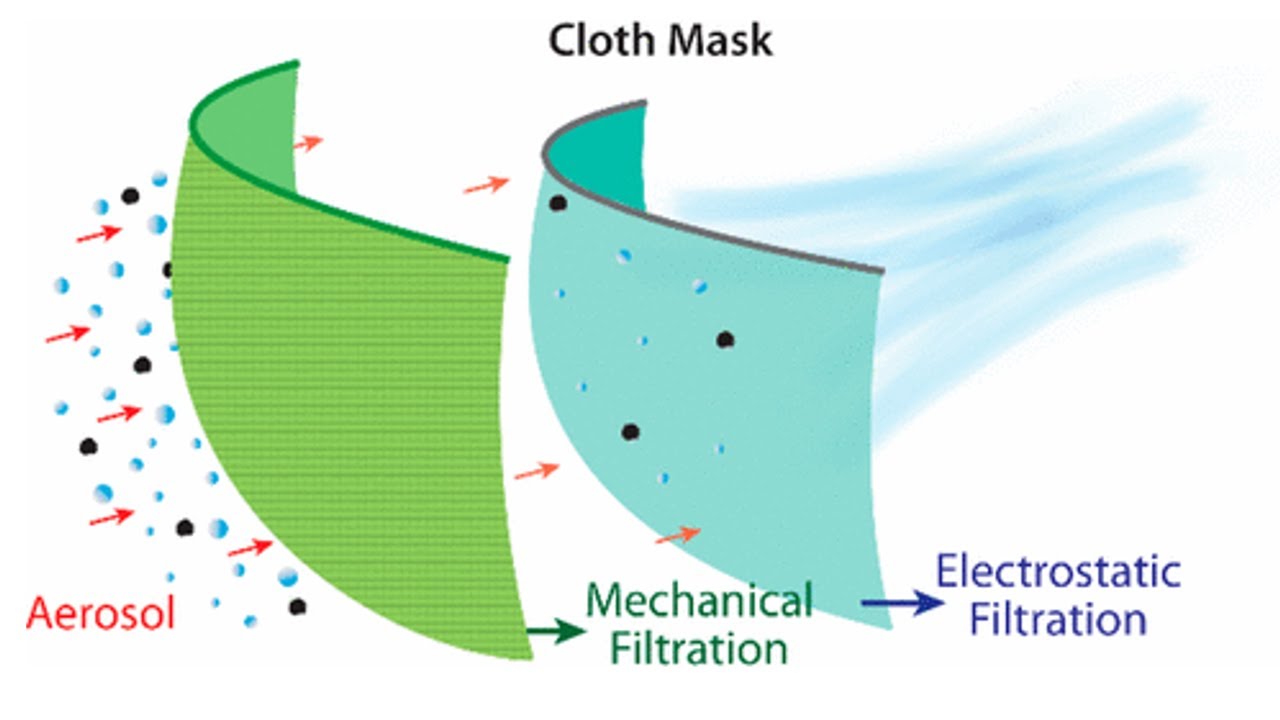
The researchers used an aerosol mixing chamber to produce particles ranging from 10 nm to 6 μm in diameter. A fan blew the aerosol across various cloth samples at an airflow rate corresponding to a person's respiration at rest, and the team measured the number and size of particles in air before and after passing through the fabric. One layer of a tightly woven cotton sheet combined with two layers of polyester-spandex chiffon -- a sheer fabric often used in evening gowns -- filtered out the most aerosol particles (80-99%, depending on particle size), with performance close to that of an N95 mask material. Substituting the chiffon with natural silk or flannel, or simply using a cotton quilt with cotton-polyester batting, produced similar results. The researchers point out that tightly woven fabrics, such as cotton, can act as a mechanical barrier to particles, whereas fabrics that hold a static charge, like certain types of chiffon and natural silk, serve as an electrostatic barrier. However, a 1% gap reduced the filtering efficiency of all masks by half or more, emphasizing the importance of a properly fitted mask.
The authors acknowledge use of the U.S. Department of Energy's Center for Nanoscale Materials user facility at Argonne National Laboratory and funding from the U.S. Department of Defense's Vannevar Bush Fellowship.

Story Source:
Materials provided by American Chemical SocietyNote: Content may be edited for style and length.

Journal Reference:
  1. Abhiteja Konda, Abhinav Prakash, Gregory A. Moss, Michael Schmoldt, Gregory D. Grant, Supratik Guha. Aerosol Filtration Efficiency of Common Fabrics Used in Respiratory Cloth MasksACS Nano, 2020; DOI: 10.1021/acsnano.0c03252

Wednesday, January 15, 2020

Meteorite contains the oldest material on Earth: 7-billion-year-old stardust

Illustration of meteor entering Earth's atmosphere (stock image).

Stars have life cycles. They're born when bits of dust and gas floating through space find each other and collapse in on each other and heat up. They burn for millions to billions of years, and then they die. When they die, they pitch the particles that formed in their winds out into space, and those bits of stardust eventually form new stars, along with new planets and moons and meteorites. And in a meteorite that fell fifty years ago in Australia, scientists have now discovered stardust that formed 5 to 7 billion years ago -- the oldest solid material ever found on Earth.
"This is one of the most exciting studies I've worked on," says Philipp Heck, a curator at the Field Museum, associate professor at the University of Chicago, and lead author of a paper describing the findings in the Proceedings of the National Academy of Sciences. "These are the oldest solid materials ever found, and they tell us about how stars formed in our galaxy."
The materials Heck and his colleagues examined are called presolar grains-minerals formed before the Sun was born. "They're solid samples of stars, real stardust," says Heck. These bits of stardust became trapped in meteorites where they remained unchanged for billions of years, making them time capsules of the time before the solar system..
But presolar grains are hard to come by. They're rare, found only in about five percent of meteorites that have fallen to Earth, and they're tiny-a hundred of the biggest ones would fit on the period at the end of this sentence. But the Field Museum has the largest portion of the Murchison meteorite, a treasure trove of presolar grains that fell in Australia in 1969 and that the people of Murchison, Victoria, made available to science. Presolar grains for this study were isolated from the Murchison meteorite for this study about 30 years ago at the University of Chicago.
"It starts with crushing fragments of the meteorite down into a powder ," explains Jennika Greer, a graduate student at the Field Museum and the University of Chicago and co-author of the study. "Once all the pieces are segregated, it's a kind of paste, and it has a pungent characteristic-it smells like rotten peanut butter."
This "rotten-peanut-butter-meteorite paste" was then dissolved with acid, until only the presolar grains remained. "It's like burning down the haystack to find the needle," says Heck.
Once the presolar grains were isolated, the researchers figured out from what types of stars they came and how old they were. "We used exposure age data, which basically measures their exposure to cosmic rays, which are high-energy particles that fly through our galaxy and penetrate solid matter," explains Heck. "Some of these cosmic rays interact with the matter and form new elements. And the longer they get exposed, the more those elements form.
"I compare this with putting out a bucket in a rainstorm. Assuming the rainfall is constant, the amount of water that accumulates in the bucket tells you how long it was exposed," he adds. By measuring how many of these new cosmic-ray produced elements are present in a presolar grain, we can tell how long it was exposed to cosmic rays, which tells us how old it is.
The researchers learned that some of the presolar grains in their sample were the oldest ever discovered-based on how many cosmic rays they'd soaked up, most of the grains had to be 4.6 to 4.9 billion years old, and some grains were even older than 5.5 billion years. For context, our Sun is 4.6 billion years old, and Earth is 4.5 billion.
But the age of the presolar grains wasn't the end of the discovery. Since presolar grains are formed when a star dies, they can tell us about the history of stars. And 7 billion years ago, there was apparently a bumper crop of new stars forming-a sort of astral baby boom.
"We have more young grains that we expected," says Heck. "Our hypothesis is that the majority of those grains, which are 4.9 to 4.6 billion years old, formed in an episode of enhanced star formation. There was a time before the start of the Solar System when more stars formed than normal."
This finding is ammo in a debate between scientists about whether or not new stars form at a steady rate, or if there are highs and lows in the number of new stars over time. "Some people think that the star formation rate of the galaxy is constant," says Heck. "But thanks to these grains, we now have direct evidence for a period of enhanced star formation in our galaxy seven billion years ago with samples from meteorites. This is one of the key findings of our study."
Heck notes that this isn't the only unexpected thing his team found. As almost a side note to the main research questions, in examining the way that the minerals in the grains interacted with cosmic rays, the researchers also learned that presolar grains often float through space stuck together in large clusters, "like granola," says Heck. "No one thought this was possible at that scale."
Heck and his colleagues look forward to all of these discoveries furthering our knowledge of our galaxy. "With this study, we have directly determined the lifetimes of stardust. We hope this will be picked up and studied so that people can use this as input for models of the whole galactic life cycle," he says.
Heck notes that there are lifetimes' worth of questions left to answer about presolar grains and the early Solar System. "I wish we had more people working on it to learn more about our home galaxy, the Milky Way," he says.
"Once learning about this, how do you want to study anything else?" says Greer. "It's awesome, it's the most interesting thing in the world."
"I always wanted to do astronomy with geological samples I can hold in my hand," says Heck. "It's so exciting to look at the history of our galaxy. Stardust is the oldest material to reach Earth, and from it, we can learn about our parent stars, the origin of the carbon in our bodies, the origin of the oxygen we breathe. With stardust, we can trace that material back to the time before the Sun."
"It's the next best thing to being able to take a sample directly from a star," says Greer.
This study was contributed to by researchers from the Field Museum, University of Chicago, Lawrence Livermore National Laboratory, Washington University, Harvard Medical School, ETH Zurich, and the Australian National University. Funding was provided by NASA, the TAWANI Foundation, the National Science Foundation, the Department of Energy, the Swiss National Science Foundation, the Brazilian National Council for Scientific and Technological Development and the Field Museum's Science and Scholarship Funding Committee.
Story Source:
Materials provided by Field MuseumNote: Content may be edited for style and length.

Tuesday, December 24, 2019

Black Gold material breakthrough!

Ethan Miller/Getty Images
“Black” gold that harvests sunlight and uses it to turn carbon dioxide (CO2) into useful chemicals and fuel, has been developed by a team of researchers from India and Seoul.
One of the most amazing things about nanomaterials, concerns their design properties. It´s astonishing how in a nanoparticle of a particular element, the same atom disposed in different geometries from that of the bulk confers a completely different behavior regarding chemical or physical properties (conductivity, resistance, melting point, etc) to that of the bulk material … it´s like we were dealing with a completely different element!
In the case of the new, and black, gold, by varying the inter-particle distance between gold nanoparticles through a cycle-by-cycle growth approach and optimizing the nucleation-growth step with dendritic fibrous nanosilica, researcher from TIFT (India) and Seoul National University, synthetized gold material which instead of reflecting light, absorbs most of it. They grew the gold in the nanostructure by laying a silica foundation whose fibers were used as the deposition site for gold nanoparticles.
Picture: © Editage/Royal Society of Chemistry
This black gold not also has the ability to absorb both visible and the near-infrared Sun radiation -which makes it a perfect candidate for high-efficiency solar panels-, but it also absorbs carbon dioxide, which is something not possible with traditional gold.
________________________
“If we develop an artificial tree with leaves made out of back gold, it can perform artificial photosynthesis, capturing carbon dioxide and converting it into fuel and other useful chemicals,” said Polshettiwar.
____________________
Researchers believe that the black gold ability to harvest solar energy can be used for portable nano-heaters which can convert seawater into drinking water via steam generation under atmospheric reaction conditions, addressing one of India´s biggest concerns.

RSF in perspective:

The outstanding dependence of a nanomaterials´ physical-chemical properties with respect to its surface-to-volume relationships is a very intriguing fact that can be interpreted by means of the holographic approach, where a fundamental nondimensional constant Φ representing the surface to volume potential transfer, is the key element for quantization of gravity.
By Ines Urdaneta, Research Scientist at Resonance Science Foundation


Fractal Pattern in a Quantum Material Confirmed for the First Time!

Image by: Arkadiusz Jadczyk

The word fractal has become increasingly popular, although the concept started more than two centuries ago in the 17th century with prominent and prolific mathematician and philosopher Gottfried Wilhelm Leibnitz. Leibnitz is believed to have addressed for the first time the notion of recursive self-similarity, and it wasn’t until 1960 that the concept was formally stabilized both theoretically and practically, through the mathematical development and computerized visualizations by Benoit Mandelbrot, who settled on the name “fractal”.
Fractals are defined mainly by three characteristics:
  1. Self-similarity: identical or very similar shapes and forms at all scales.
  2. Iteration: a recursive relationship limited only by computer capacity. With sufficiently high performance, the iterations could be infinite. This allows for very detailed shapes at every scale, that modify with respect to the first iteration, manifesting the original shape at some levels of iteration. Because of this, fractals may have emergent properties, which make them a suitable tool for complex systems.
  3. Fractal dimension, or fractional dimensions: describes the counter-intuitive notion that a measured length changes with the length of the measuring stick used; it quantifies how the number of scaled measuring sticks required to measure, for example, a coastline, changes with the scale applied to the stick.
___________________________________
The fractal dimension of a curve can be explained intuitively thinking of a fractal line as an object too detailed to be one-dimensional, but too simple to be two-dimensional.7
Although fractals now-a-days are commonly used for the macroscopic regime such as the branches of a tree, a broccoli, blood vessels and many others, for the first time physicists at MIT have discovered fractal-like patterns in a quantum material. The material is neodymium nickel oxide or NdNiO3, a rare earth nickelate that conduces electricity or acts as an insulator, depending on its temperature. It also presents inhomogeneous magnetism: domains or regions with a specific magnetic orientation that vary in size and shape throughout the material. The material exhibits this peculiar electronic and magnetic behavior as a result of quantum, atomic-scale effects, and for this reason it is called a quantum material.
The researchers had to design a very special X-ray-focusing lens in order to map the size, shape, and orientation of magnetic domains point by point at different temperatures, confirming that the material formed magnetic domains below a certain critical temperature. Above this temperature, the domains disappeared erasing the magnetic order. Nevertheless, if they cooled the sample back to below the critical temperature, the magnetic domains reappeared almost in the same place as before! This means that the system has memory, which was very unexpected. One could have a system robust against external perturbations, even if subjected to heat, such that the information is not lost.
Secondly, after mapping the material’s magnetic domains and measuring the size of each domain, the researchers counted the number of domains of a given size and plotted their number as a function of size. The resulting distribution showed the same pattern again and again, no matter what range of domain size they focused on. They found that these magnetic patterns have a fractal nature!
___________________________
“It was completely unexpected — it was serendipity.”
-Riccardo Comin, assistant professor of physics at MIT.
Because the material acts as an insulator or conductor depending on the temperature, scientists are exploring neodymium nickel oxide for neuromorphic devices — devices that mimic biological neurons. Here, temperature would play the role of voltage in the biological system, which is active or inactive depending on the voltage that it receives. Another potential application is resilient, magnetic data storage devices.